Agenda-setting intelligence, analysis and advice for the global fashion community.
Agenda-setting intelligence, analysis and advice for the global fashion community.

By 4 a.m., the Santa Fe Plaza is already awake.
On a late August morning, hundreds of artists are unloading trucks and stringing lights in brisk high-desert dark, setting up booths hours before the sun clears the Sangre de Cristo Mountains. It’s a quiet, unglamorous start to what has become the country’s largest Native art market, and for many Indigenous fashion designers, the place their careers may actually begin.
Flanked by dozens of galleries and shops full of handmade wares, the terra cotta city — the highest capital by elevation in the US — is a hub for Native design and home to the largest Native art school, the Institute of American Indian Arts. Every August and November, in thin air and mid-eighty-degree heat that infrastructure turns into a launchpad. Museum curators and private collectors who’ve built relationships with Santa Fe galleries, arrive to scout the market’s newest work. For many designers, a first major sale or placement often traces back to one of those long-standing relationships rather than a cold discovery.
“I think of support in two ways: social and financial,” said Nic Walters, a former Santa Fe local who visited for the August market. “At the Indian Market, that means cheering on amazing artistry and putting money in people’s pockets.”
ADVERTISEMENT
For Native designers, Santa Fe Indian Market is where a career can really start: a few days a year when collectors and curators come looking, and when a runway gives fashion a stage alongside the pottery and jewellery. But the market is an impetus, not a full-fledged economy. Once the tents are taken down, just a few of these designers actually have a year-round retail home in Santa Fe or wholesale pipeline to carry them forward. Even the most well-recognised, like Jamie Okuma and Virgil Ortiz, have had to build that infrastructure themselves.
Jamie Schulze, the executive director of The Southwestern Association for Indian Arts or SWAIA, which runs the market, said that “at this time,” SWAIA does not have the infrastructure to help designers catapult to the next level.
Still, it’s proven a place of opportunity.
“I’ve been able to build my relationships over about 15 years with both collectors and museums that came and visited the booth,” said photographer Cara Romero, who occasionally enlists the market’s designers as subjects in her art, which is displayed at her nearby eponymous gallery. “A first placement typically comes out of those long-time relationships.”
Founded in 1610 as a Spanish colonial capital, Santa Fe’s role in Native art began three centuries later and on someone else’s terms: in 1922, white anthropologists founded what would become SWAIA as part of an effort to preserve Pueblo pottery and Diné weaving.
A century on, the week itself actually belongs to the people it once just treated as subjects to be catalogued.
Today, artists sell straight to the public from their own booths, with no gallery or wholesale buyer in between. They pay a $40 application fee, and if accepted into the market, are conferred with a small booth space. For customers, market admission is free, and visitors buy directly from more than 1,000 juried artists, who switch between sales, Indian taco runs, and handing off booth duties to family to gossip with others who spend the rest of the year scattered across the country — making the most of the one week a year this scene exists in one place at all.
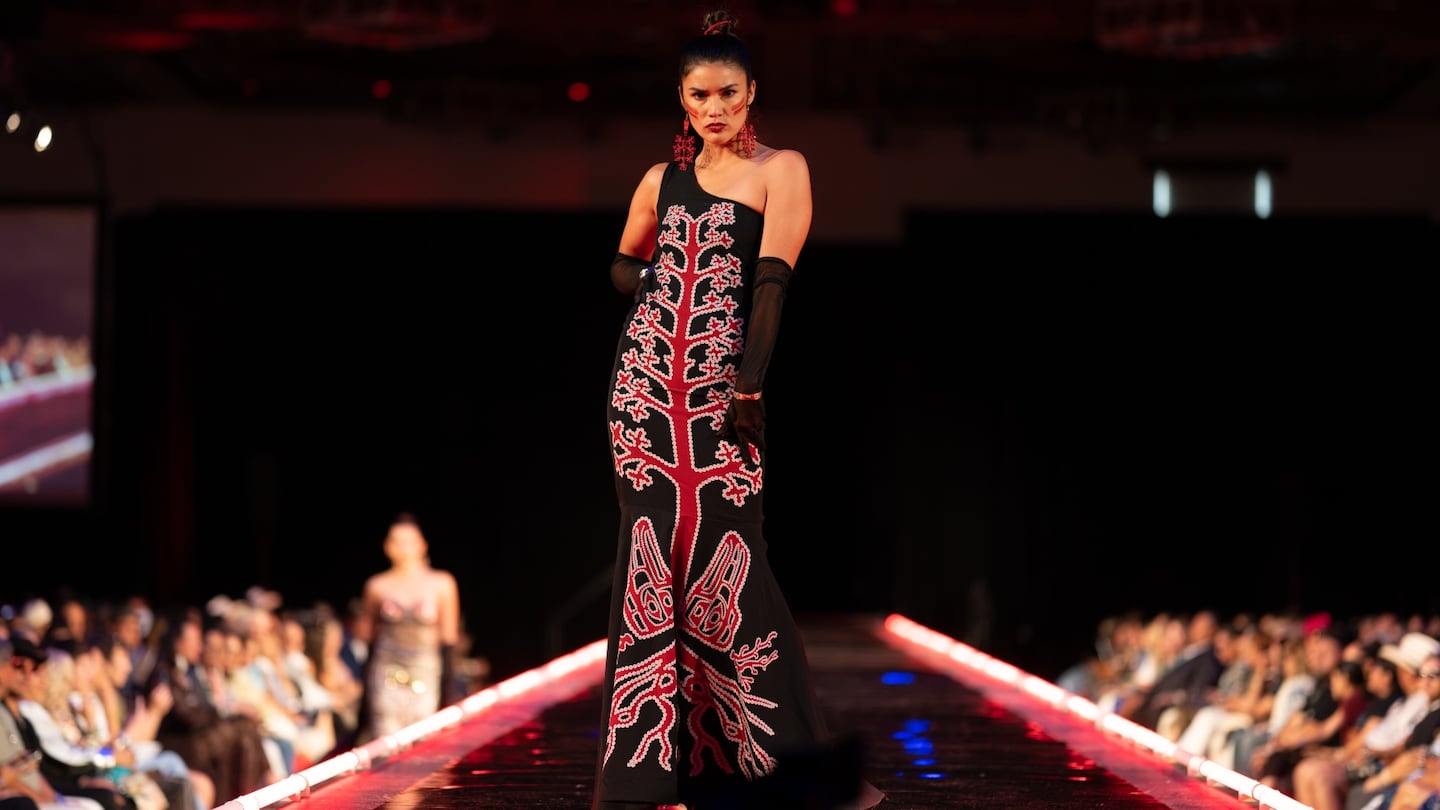
Fashion took longer than most mediums to find its footing in this world. Since 2014, there’s been a runway show, hosted at a convention centre near the plaza. It drew in model-turned-designer and producer Peshawn Bread, who last year infused it with an LGBTQ sensibility and subsequently launched her own brand, House of Sutai.
ADVERTISEMENT
“I can think of Virgil Ortiz and Bethany Yellowtail doing boutique pop-ups — even before the runway existed,” said Romero. “We’ve always made wearable art, and it seems like a natural evolution. I feel like sometimes the art world has to catch up to what we’re already doing.”
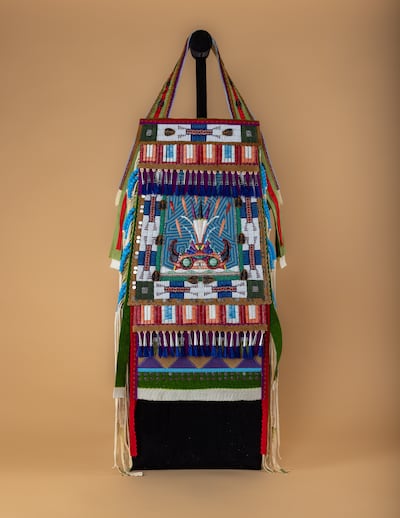
This year, SWAIA introduced its first application process for designers, replacing a system where designers were hand-selected by a panel from the field.
“So often the organisation gets accused of being subjective, and we have to be very thoughtful with our processes,” Schulze said. She says she wants “a more contemporary classification” for fashion, which at the moment sits under textiles.
And then there’s the matter of getting the right people to attend. Tia Collection, the Gochman Collection, and Forge Project in New York, Denver Art Museum, and Hood Museum at Dartmouth come to Santa Fe for visual art, several with fashion now entering their collections. But on the commercial side, industry attention has clustered primarily around SWAIA’s separate May Native Fashion Week. Last year, for instance, several retailers attended that event, but not August’s market.
The models continue to walk, year after year, armored in glittering silver, turquoise and couture. But once the week’s vendors, collectors, and tourists clear out, most of that work disappears from Santa Fe entirely. None of the local stores carry SWAIA designers; most of the artist’s work featured that week is only available afterward online.
Okuma, a Shoshone-Bannock and Luiseño tribal member, had her beadwork first accepted into the Santa Fe Indian Market at 18 and became the youngest ‘Best in Show’ winner at 22. Today, the Market, once responsible for 90 percent of Okuma’s business, now represents only 5 percent. That’s not because of lack of demand, she said, but deliberate choice as her website and institutional contracts expanded to carry most of her revenue.
Okuma has been building her brand since her teens, well before the social media era reshaped how Native designers reach buyers directly. Her eponymous brand features online ready-to-wear and couture; Okuma prints images of her beadwork and Native design motifs on industrial materials for accessible lines, while her couture requires intensive handwork and traditional materials. When the CFDA came calling, they were interested in listing her as a member, she asked directly whether she was being tokenised. She was surprised when they said, “they’ve been watching for a long, long time.”
Okuma’s trajectory may augur a broader path for Native designers navigating between Market and the mainstream industry; though, so far few have followed.
ADVERTISEMENT
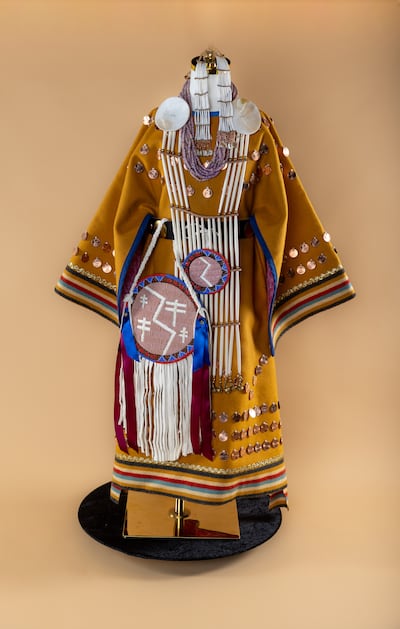
“My team and I are mobile, traveling to showrooms and venues in cities where I have exhibitions,” he said “Santa Fe Indian Market remains one of the biggest events we participate in each year.”
For designer Patricia Michaels, Indian Market relationships provided the durable foundation sustaining her until her professorship appointment at Parsons, over a decade after she appeared on “Project Runway” in 2013. She now teaches alongside Amber-Dawn Bear Robe, who left Santa Fe for New York the same way — joining Parsons’ Indigenous design cluster roughly a decade after helping to launch SWAIA’s runway in 2014.
Today, Michaels generates 80 percent of her income from Market-related work, excluding her new Parsons salary. It’s a tie she won’t cut.
“Some people in the industry were saying, ‘Well you no longer have to do Native art shows anymore. You can leave the scene and just be part of the big fashion world,’” says Michaels. “And I was like whoa, no, wait – first, I’m Native, so I’m doing this because I’m Native, and that’s where I enjoy myself. Whatever I make is going to be enough, because I’m busy with ceremonies, and I’m not going to leave that part of my life.”
From handmade beadwork to woven bags, small labels that create products via ancestral methods must constantly weigh how to scale without sacrificing integrity.
Though appropriation of Native art and traditions still exists in fashion, more brands are finding ways to ethically work with Native designers and communities.
The four years since Quannah ChasingHorse was discovered by a Calvin Klein scouting director have seen a wave of Native talent appear on magazine covers and in high-profile shows. But for an industry that’s coasted on lazy depictions of Indigenous culture, old habits die hard.
Loading recommended reads…
French entity Coperni SAS will cease operations after the brand failed to reach an agreement with stakeholder and distributor Tomorrow, founders Arnaud Vaillant and Sébastien Meyer said.
The French private equity group announced on Wednesday that it will buy the UK skin and body care brand for an undisclosed sum.
At its capital markets event in Shanghai, leadership said it aims to deliver mid-single-digit organic net sales growth through fiscal 2030, and unveiled a new cost-cutting and strategic roadmap.
The Indian beauty retailer said on Wednesday its second-quarter profit nearly tripled, as improved operating efficiency and strong demand for premium beauty products boosted margins.