Agenda-setting intelligence, analysis and advice for the global fashion community.
Agenda-setting intelligence, analysis and advice for the global fashion community.
For fashion brands, the question is no longer whether to invest in AI visibility, but whether that investment is working. Forty-one percent of US consumers used generative AI to shop in June 2026, while visitors referred by AI generated over 40 percent more revenue per visit than those arriving through traditional channels, according to Adobe Analytics.
Unlike search engines, where brands can secure visibility through organic rankings or paid placement, AI assistants recall and recommend brands using a combination of learned representations and, in some cases, information retrieved through live web searches.
This means a brand can be well known to an AI model yet rarely recommended. It may appear frequently but for the wrong products, audiences or occasions. Or it may consistently feature in responses, only to be placed behind competitors when recommended.
To understand these differences, BoF Insights analysed 120 luxury, high street, contemporary and sportswear / outdoor brands across ChatGPT, Claude and Gemini between January and July 2026. The study draws on data from BoF Insights Brand Pulse, BoF’s proprietary fashion and luxury brand-tracking tool, developed in partnership with Quilt.AI. Brand Pulse measures performance across AI platforms, social media and search, and now includes a dedicated AI Performance module assessing three measures:
ADVERTISEMENT
Explore Brand Pulse to understand how AI represents, recommends and places your brand against its competitors.
Across the brands analysed, 78 percent increased their recommendation frequency between January and July 2026. Yet the brands recommended most frequently changed relatively little. On average, four of the five brands with the highest recommendation frequency in January remained in the top five in July.
The findings suggest that rising recommendation frequency does not necessarily represent competitive gain. As more brands improve their visibility, performance must be judged against relevant peers and within the prompts that matter most to the business.
No single brand dominated every aspect of AI performance. For example, in luxury Zegna achieved the strongest understanding score, Burberry was recommended most frequently and Chanel secured the highest average placement. The same pattern appeared across other segments, with different brands leading on understanding, recommendation and placement.
Brands that AI recommends more often also tend to rank higher than their peers when they are recommended. Among the segments analysed, the relationship is strongest in luxury, where AI assistants repeatedly return to a relatively established order of brands.
Understanding scores, meanwhile, work independently. Across all 120 brands assessed, we found little to no relationship between how often a brand was recommended and how well AI understands it.
But this raises an important consideration. A tightly defined brand may be relevant to only a narrow set of needs, limiting its reach. A frequently recommended brand with generic or inconsistent associations may appear widely, but AI may surface it for the wrong products, audiences or occasions. Neither strength is sufficient on its own.
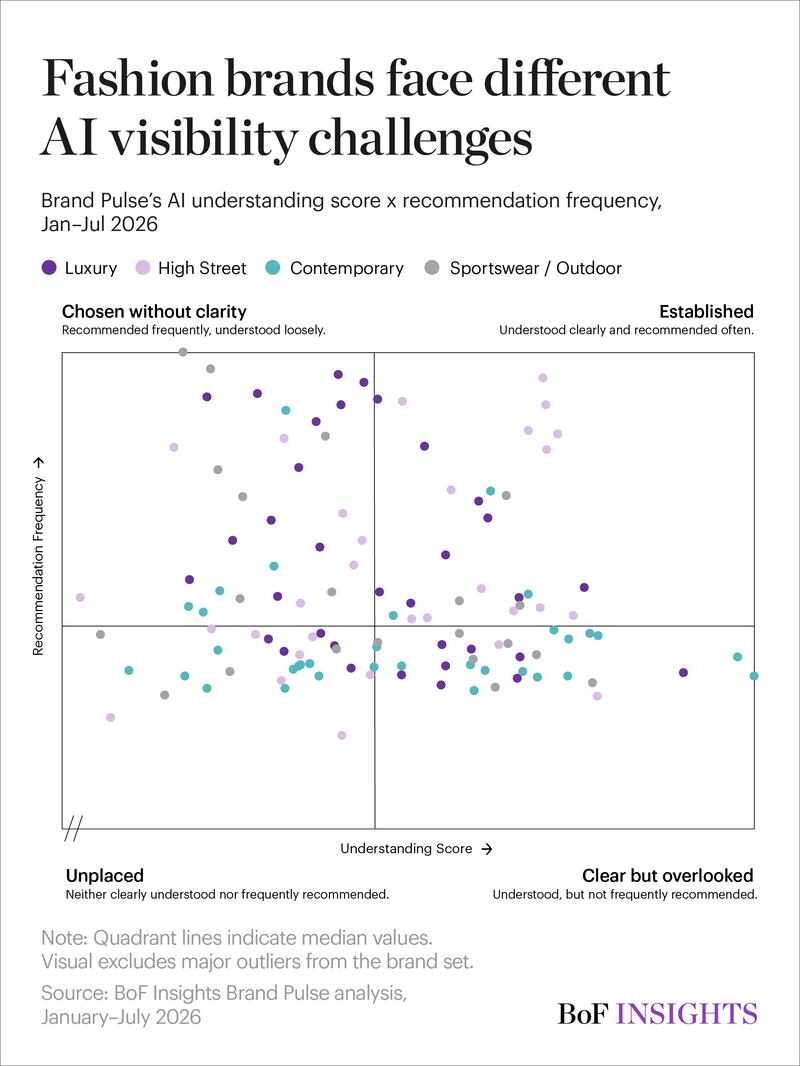
Comparing fashion brands’ understanding scores with recommendation frequency in AI reveals four competitive positions:
ADVERTISEMENT
Each position calls for a different response. Established brands must defend and extend their lead, while brands chosen without clarity need to strengthen the associations shaping their representation. Clear but overlooked brands need to broaden their relevance across more prompts. Unplaced brands must first build a clearer foundation before pursuing greater reach.
Download the full BoF Insights report, How Fashion Brands Get AI Visibility Right, to explore the findings and recommended actions for each competitive position in the AI visibility matrix, and explore BoF Insights Brand Pulse to benchmark how AI represents and recommends your brand against its competitors.
Loading recommended reads…
In this week’s High Margin, a search for images that cut through our visual fatigue — with leads from M/M Paris, Ferdinando Verderi and stylist Emilie Kareh. Plus: Tod’s designer exit; Burberry’s resilient sales.
The producer price index rose 6.5% from October 2025, an acceleration from the prior month, according to Bureau of Labor Statistics data out Friday. On a monthly basis, the PPI increased 0.3%.
The creative director and strategist joins Imran Amed on The BoF Podcast to discuss the evolution of his career, the realities of shaping artist narratives and why long-term collaboration outperforms short-term marketing.
The former Nvidia CEO was central to an AI boom that has propelled the US stock market and fueled the country’s unmatched luxury spending. After his exit, nobody is sure what happens next.