Agenda-setting intelligence, analysis and advice for the global fashion community.
Agenda-setting intelligence, analysis and advice for the global fashion community.

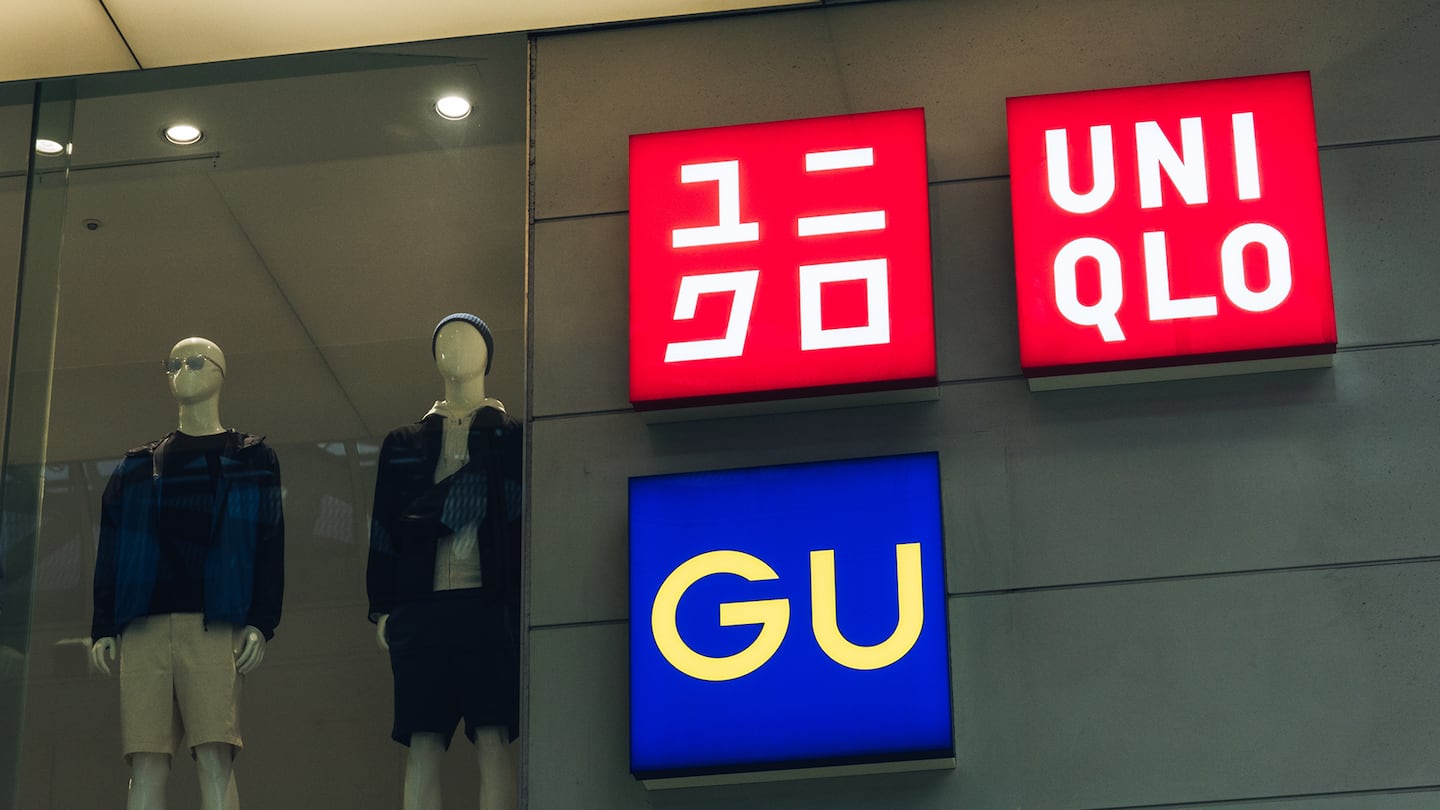
Uniqlo’s ability to churn out functional and comfortable basics at affordable prices has put owner Fast Retailing Co. on the cusp of surpassing rival Hennes & Mauritz AB in annual revenue. But to get within striking distance of the fast-fashion industry’s biggest players Shein Group Ltd. and Zara-owner Inditex SA, the Japanese retailer will need another growth engine.
It has one in the form of GU, pronounced “gee-you,” which sounds like the Japanese word for freedom, a cheaper and trendier brand that isn’t well-known outside of Asia. GU does have what it takes to become a mass fashion powerhouse alongside the more established sibling. However, delivering on that potential will require a far more ambitious global rollout than the group has managed so far.
Enter Francesco Risso. The former Prada SpA designer and creative director at Italian luxury label Marni, whose first collection for GU will be introduced in New York on Friday, will help accelerate this push. So, too, should Fast Retailing’s efforts to strengthen its sustainability credentials and a growing shift among Gen-Z shoppers away from the ultra-fast-fashion trends popularized by Shein and Temu, a unit of China’s PDD Holdings Inc.
GU will need to grow quickly beyond its 480 stores, the vast majority of them in Japan. Fast Retailing chief executive officer Tadashi Yanai has set a long-term goal of 1 trillion Japanese yen ($6.1 billion) in yearly revenue for the budget brand, saying it has the potential to become a second Uniqlo. That’s about three times more than the annual sales reported in the most recent financial year. By comparison, Uniqlo is roughly nine times bigger with more than 2,500 stores.
ADVERTISEMENT
The brand can succeed by taking a cue from Shein’s ability to appeal to younger shoppers. But it has the opportunity to distinguish itself by steering clear of the industry’s relentless product churn and throwaway culture. The clothes will hardly be couture, but neither should they emulate a business model where thousands of styles are introduced every day.
Risso’s hiring in January signaled a strategic revamp: giving the label an elevated design pedigree while still keeping it accessible. At just 2,990 Japanese yen, GU’s jeans are about 2,000 Japanese yen cheaper than Uniqlo’s, putting it in the same range as Shein’s offerings.
His debut is more substantial than typical fast-fashion fare. A checked jacket and a pair of pleated wide pants I tried on at a Hong Kong store could easily pass as so-called wardrobe-building items; timeless styles that can be mixed with other clothing. Better quality pieces can give it more pricing power, which could help GU narrow the margin gap with Uniqlo.
To achieve its targets, the label will need to move with more urgency after an expansion effort 10 years ago failed to fully deliver. Outside Japan, GU has stores in mainland China, Hong Kong and Taiwan, but its global footprint has barely expanded over the past three years. It has just one US location, a global flagship in Manhattan’s SoHo, and none in Europe.
This is an obvious growth opportunity that Fast Retailing should seize. One way to do so would be to leverage Uniqlo’s network of more than 90 locations across the continent by introducing GU through pop-up spaces before rolling out standalone outlets. The group followed a similar strategy before opening GU’s New York City store.
The timing is particularly favorable because Chinese online retailers are facing growing reputational and regulatory challenges in Europe. That could create an opening for GU, whose model is based on branded apparel sold through its own stores rather than an open marketplace where it has less control.
Shein is being investigated by the European Commission following complaints from French authorities that child-like sex dolls had been listed on its platform. On Monday, the bloc fined AliExpress, owned by Alibaba Group Holding Ltd., a record €550 million ($629 million) for selling illegal products. As Europe’s trade deficit with China ballooned beyond $1 billion a day, websites hawking Chinese-made goods are sure to come under ever greater scrutiny.
That gives Fast Retailing an opportunity to position GU as the antidote to ultra-fast fashion rather than another participant in it. Younger shoppers still want affordable clothing, but they are becoming more discerning about quality, sustainability and the brands they buy from. If Yanai can expand GU aggressively while preserving those qualities, it won’t just have built a second Uniqlo. It could create, alongside Zara, another group that could credibly challenge Shein.
By Juliana Liu
GU, a lower-priced counterpart to Uniqlo, is betting a former luxury fashion designer can help turn $18 jeans into global success.
The former Marni creative director will also release a collaboration with Fast Retailing’s flagship brand, Uniqlo, later this year.
Loading recommended reads…
The company is counting on demand for its AI glasses with Google and Samsung to grow in the coming years, while trying to head off concerns they can be used to record people without consent.
The suspects stole more than €1 million worth of jewellery before fleeing on motor scooters, according to reports.
This week, Priya Rao takes a closer look at why beauty is moving up-market and how a collaboration breaks through today.
Jensen Huang’s exit deepens the crisis at the chipmaker at the centre of the AI rally that’s powered new wealth creation in the US, luxury fashion’s most important market.