Agenda-setting intelligence, analysis and advice for the global fashion community.
Agenda-setting intelligence, analysis and advice for the global fashion community.

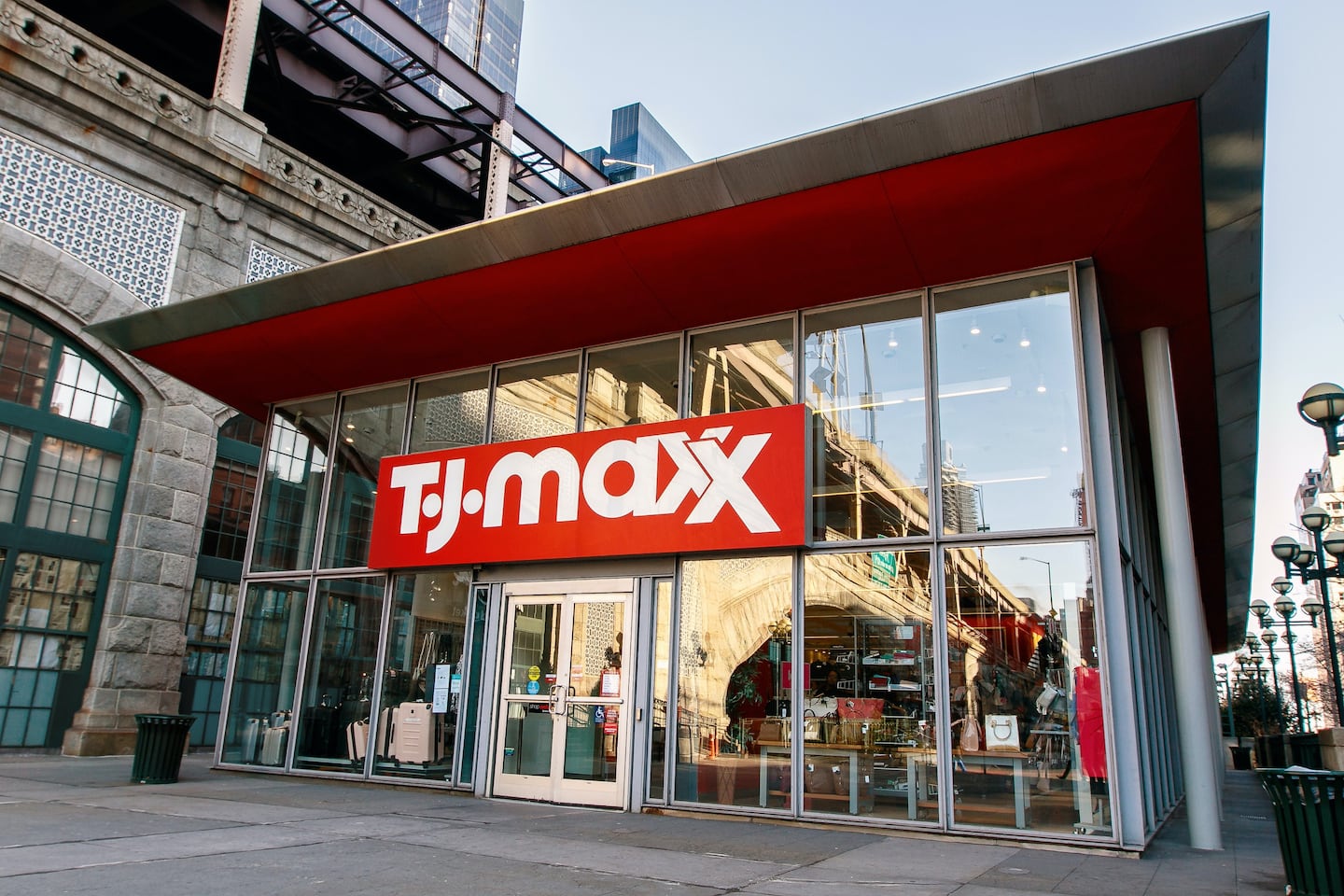
There’s a new luxury retailer on the block.
I’m not talking about Printemps’ New York City store on Wall Street, or 40 Duke, Selfridges’ private members’ club that offers big spenders early access to the hottest collections.
TJX Cos Inc., owner of TJ Maxx and Marshalls in the US and TK Maxx in Europe, has quietly become a potent force in top-end goods, selling cut-price finery including Gucci handbags, Ralph Lauren cowboy boots, Givenchy T-shirts and Alaia dresses.
The discount retailer, with its treasure-hunt feel, might seem anathema to the exclusive, rarefied world of luxury. But after pushing up prices amid the 2020-2023 boom, designers are struggling to connect with consumers who are financially comfortable enough to splurge on the occasional luxe treat, but not actually rich.
ADVERTISEMENT
A brand showing up in TJ Maxx, at a more reasonable price, could help reach those who have given up on fancy fripperies. Like an affordable perfume or the second-hand market, it could ignite shopper interest, particularly among the young, who have flocked to the chain and may go on to buy later at full price.
But there are perils for both luxury houses and TJX. For luxe names, having too much stock available in TJ Maxx can cheapen their image. For the discount retailer, too many chichi labels can turn off its core value-oriented customers.
TJX sells premium and luxury items under the Runway brand in the US and Gold Label in Europe. Its buyers are constantly looking for new inventory, taking advantage of department stores canceling orders, brands wanting to clear end-of-season lines and other opportunities, the retailer said.
Between the turmoil in the department store sector, with the owner of Saks Fifth Avenue and Neiman Marcus entering Chapter 11 in January, and luxury’s three-year sales slump, there is likely to have been a surfeit of high-end stock in the broader retail ecosystem recently. Destroying overstock is frowned upon — and banned for large companies in Europe — so excess supply must go somewhere.
Big names, though, tend to distance themselves from the off-price retailer. The Gucci items at TJX do not come directly from the Italian house, while Mulberry Group Plc, whose products can also be found on the discounter’s shelves, does not have a relationship with TJX.
That said, the alternatives to TJX have their own problems. Between luxury “greedflation” and many houses targeting the 1 percent, even big bling’s traditionally lower echelons are now out of reach for many. Flagship stores on New York’s Fifth Avenue and London’s Bond Street have almost become museums, where people come to look, not buy. Luca Solca, an analyst at Bernstein, recently wrote that when luxury companies have sold their leftovers at their own off-price locations, they have been tempted to pad out their offerings with brand-damaging “made for outlet” items.
So perhaps TJX is a better option, particularly as its luxury exposure is still relatively limited. The retailer said that of its more than 2,500 TJ Maxx and Marshalls stores in the US, just over 100 offer Runway. It has recently introduced the range in about 10 stores in Canada. In Europe, Gold Label is available in fewer than 10 percent of its more than 600 TK Maxx outposts. Although Runway is online in the US, and Gold Label is available digitally in the UK, Germany and Austria, only 2 percent of TJX’s sales are made via e-commerce.
Buying your big brand names at TJX is quite a different experience from browsing at a posh boutique. The luxury goods that make it to the retailer are usually from a past season — though they are still expensive. A black Gucci tote bag, originally priced at £1,860, was almost £1,000 on the UK site. An Alaia dress was just under £500 and available only in one size — it quickly sold out. TJX has also introduced a small selection of authenticated “pre-loved” luxury items on its European websites and in a few of its TK Maxx stores.
ADVERTISEMENT
Things do sometimes go wrong. Brunello Cucinelli came under fire from Morpheus Research a year ago. The short seller alleged that its pricey cashmere was on sale at the discounter.
Many brands are acutely aware of the danger. Ralph Lauren Corp. uses off-price strategically, to flush out excess inventory. But the US company, which also operates its own outlet stores, has more than halved its exposure to the discount channel since beginning its turnaround almost a decade ago.
TJX says it has carried luxury, high fashion and premium beauty items for over 20 years. The selection has gradually increased since 2018, according to Simeon Siegel, an analyst at Guggenheim Securities, helping the chain outperform the competition.
Yet TJ Maxx and Marshalls suffered a rare sales miss in TJX’s fiscal second quarter. This week, the company told Barclays Plc’s consumer conference that the slowdown was due to the wrong selection of products, not higher prices. But too much expensive inventory could send hard-pressed shoppers to cheaper off-price rivals such as Burlington Stores Inc.
TJX has clearly gained from luxury’s pain. Many tony brands are now finding ways to reconnect with the middle class that could cut out discounters — through cosmetics lines at LVMH Moet Hennessy Louis Vuitton SE’s Louis Vuitton, for example, or by offering some cheaper handbags at Gucci’s own stores.
And the industry is taking steps that could mean less posh stock sloshing around for TJX to scoop up. Luca de Meo, CEO of Gucci’s parent, Kering SA, is aiming to reduce inventory in its fashion houses by €1 billion by the end of this year. He is also drawing on his experience in the automotive industry to ensure it doesn’t overproduce. Saks Global, meanwhile, exited Chapter 11 in June as Exemplar Luxury Group.
Get that cut-price Gucci handbag while you can.
By Andrea Felsted
ADVERTISEMENT
Learn more:
TJ Maxx, Marshalls Suffer Slowdowns as US Spending Tapers
TJX Companies reported slowdowns at the off-price apparel chains on Wednesday, fueling concerns about a pullback in US consumer spending.
Loading recommended reads…
In this week’s High Margin, a search for images that cut through our visual fatigue — with leads from M/M Paris, Ferdinando Verderi and stylist Emilie Kareh. Plus: Tod’s designer exit; Burberry’s resilient sales.
The producer price index rose 6.5% from October 2025, an acceleration from the prior month, according to Bureau of Labor Statistics data out Friday. On a monthly basis, the PPI increased 0.3%.
The creative director and strategist joins Imran Amed on The BoF Podcast to discuss the evolution of his career, the realities of shaping artist narratives and why long-term collaboration outperforms short-term marketing.
The former Nvidia CEO was central to an AI boom that has propelled the US stock market and fueled the country’s unmatched luxury spending. After his exit, nobody is sure what happens next.