Agenda-setting intelligence, analysis and advice for the global fashion community.
Agenda-setting intelligence, analysis and advice for the global fashion community.


What's up, down and making news this week in the fashion and beauty businesses.
Nearly 15 years after affiliate links became a norm in influencer marketing, Meta is getting in on the action.
This week, the tech giant rolled out its second attempt to allow creators to add affiliate links — where an influencer gets a cut of a sale when a follower makes a purchase off of a link they share — directly in Reels on Instagram and Facebook through product tags. The implications are potentially huge: Instagram remains one of the most important channels for influencers, particularly in fashion, to connect with their followers; the ability to earn affiliate income directly from the app itself could be a game-changer.
But while it’s a major move for Instagram, it’s not particularly revolutionary. Affiliate marketing has been the backbone of the influencer industry since its infancy, and plenty of players have stepped up to fill the void in Instagram’s lack of capabilities. In fashion, the two most notable are LTK, the earliest contender in this space, launched in 2011, and fast-growing challenger ShopMy, which nabbed a $1.5 billion valuation last year. Retailers like Amazon and Sephora also operate their own online storefront programmes.
Today, these other options are so embedded in the influencer ecosystem that it begs the question: Is Instagram’s entry into affiliate marketing simply too little, too late?
ADVERTISEMENT
Despite the delayed arrival, Instagram certainly has plenty of baked-in advantages. For one, users are able to check out within the Instagram app itself, a function it introduced in 2019, which makes cart abandonment less of an issue. On top of the typical commission, Instagram will pay top creators an additional 1 percent.
TikTok’s foray into the affiliate world has been successful: Since its 2023 debut, TikTok Shop has attracted 100,000 creators to its programme. But Instagram’s own efforts to become an e-commerce engine have faltered in the past, as people typically use the platform for discovery, not purchasing. Its first in-app affiliate programme trial was sunset in 2022 after a year.
But whether Instagram can attract enthusiasm from its creators is less certain. The relationship between the app and influencers has long been tenuous. The platform was slow to embrace influencers, even as their followings blossomed and earning potential skyrocketed. For much of the 2010s, it seemed as if they were, if not deliberately handicapping them, then at the very least, ignoring their needs. Unannounced algorithm changes could collapse an influencer’s reach or engagement overnight. The pivot towards video forced creators to rush to change their content strategies. Instagram only launched its Creator Marketplace, which helps match influencers with brand partners, in 2022; a widespread global rollout didn’t happen until 2024.
Even today, the two sides continue to butt heads: Instagram offers ad revenue to only a select group of invited creators while both TikTok and YouTube have more generous policies. And just in February, several influencers criticised Instagram for deploying a new AI-enabled “Shop the Look” feature on their posts, recommending similar products without their consent — or shared commission.
Instagram’s sluggish uptake opened the door for others to come in and snag market share, most notably LTK and ShopMy, which offer not only affiliate linking but a full suite of features designed to help creators make money, as well as detailed data on the products their followers are clicking and buying.
A touted benefit of Instagram’s affiliate services is that it isn’t taking a cut of any of the sales. The reality is more complicated. The size of Instagram’s cut doesn’t really matter if it isn’t reflected in higher commission rates for the creators themselves. A spokesperson for Meta confirmed that commission rates will be dictated by the brand, as they are on ShopMy and LTK. Plus, if Instagram isn’t making money directly off these sales, it inevitably means they have less of a vested interest in the programme itself.
It’s commendable that Instagram is recognising creators’ power and rolling out new tools to help them do business on the platform, and given its scale, it’s a near certainty that many creators will try it out. But with advanced affiliate capabilities available in abundance elsewhere, it’s hard to imagine that creators — particularly in fashion — will abandon those services en masse to embrace Instagram’s new features.
An early indicator? When Instagram head Adam Mosseri’s post announced the affiliate launch this week, many influencers commented asking if they’d be able to use the feature with their ShopMy and LTK links. (For the record, the answer right now is no.)
ADVERTISEMENT
By Diana Pearl
Go Deeper:
The Creator Economy’s Coming-of-Age Moment | Editor’s Letter
With influencer marketing sector expected to hit $44 billion this year, The Business of Fashion is looking deeper at this rapidly changing industry with a special package on the stakes it’s facing today.
Who’s up and down in the business of fashion, luxury and beauty this week.
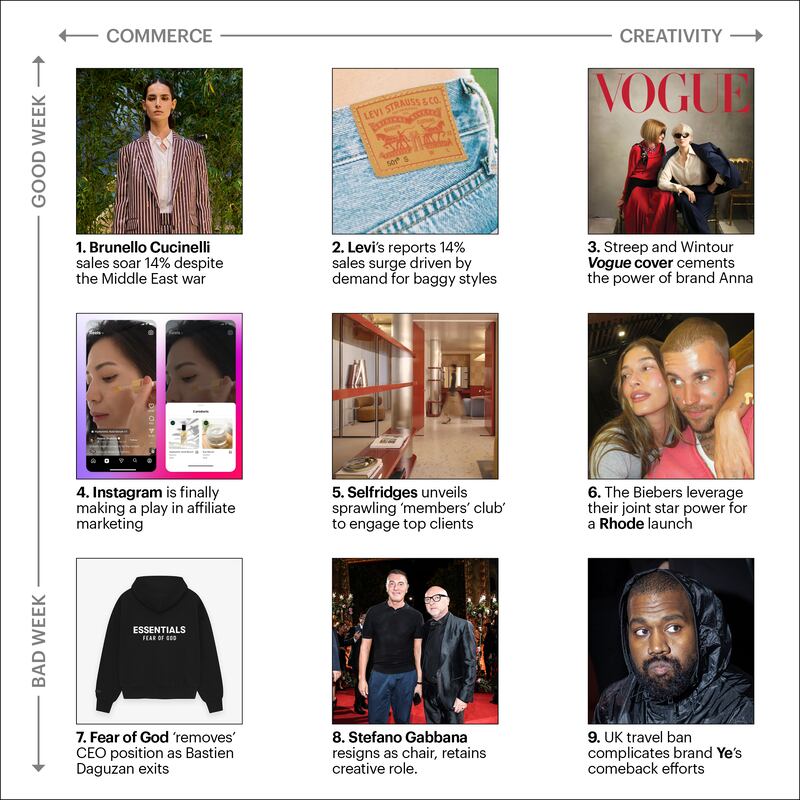
1. Brunello Cucinelli sales soared 14 percent in the first quarter, offering early signs that the luxury market is holding up despite the outbreak of war in the Middle East.
2. Levi’s posted a double-digit sales lift in the first quarter and raised its full-year outlook, driven by demand among young consumers for baggy styles and strong direct-to-consumer sales.
3. Meryl Streep and Anna Wintour appeared together on the latest Vogue cover in a brilliant marketing masterclass that gave both “The Devil Wears Prada 2″ and brand Anna a boost.
ADVERTISEMENT
4. Instagram is finally making a play in affiliate marketing by allowing users to add product links directly in the captions of reels, but the move feels too little too late to challenge the dominance of ShopMy and LTK.
5. Selfridges has opened a 25,000-square-foot “members club” for its top spenders, complete with a private restaurant, café, spa treatment rooms and VIP shopping suites.
6. Hailey Bieber tapped into her husband Justin’s star power with a limited-edition Rhode collaboration timed to his Coachella performance.
7. Fear of God CEO Bastien Daguzan is exiting the company following its “decision to remove the office of the CEO from its organisational structure.”
8. Dolce & Gabbana confirmed that Stefano Gabbana had resigned from his position as chairman in December as the company seeks to refinance its debt amid a sector-wide slump.
9. The UK’s decision to ban Ye from the country could push neighbouring nations to do the same, complicating the rapper’s European summer tour and efforts to rehabilitate his image.
Catch up on all the news of the week in fashion, luxury and beauty here.

Diana Pearl is US Editor at The Business of Fashion. She is based in New York and drives BoF’s marketing and media coverage.

Cathaleen Chen is Retail Editor at The Business of Fashion. She is based in New York and drives BoF’s coverage of the retail and direct-to-consumer sectors.
Loading recommended reads…
In this week’s High Margin, a search for images that cut through our visual fatigue — with leads from M/M Paris, Ferdinando Verderi and stylist Emilie Kareh. Plus: Tod’s designer exit; Burberry’s resilient sales.
The producer price index rose 6.5% from October 2025, an acceleration from the prior month, according to Bureau of Labor Statistics data out Friday. On a monthly basis, the PPI increased 0.3%.
The creative director and strategist joins Imran Amed on The BoF Podcast to discuss the evolution of his career, the realities of shaping artist narratives and why long-term collaboration outperforms short-term marketing.
The former Nvidia CEO was central to an AI boom that has propelled the US stock market and fueled the country’s unmatched luxury spending. After his exit, nobody is sure what happens next.