The Most Desirable Fashion Companies to Work for in 2026
Chanel, Hermès and Dior lead the pack as 1,173 fashion professionals and aspiring workers from 93 countries tell BoF Careers which brands they most want to work for — and why.
Chanel, Hermès and Dior top the 2026 BoF Careers ranking. Respondents see them as brands with enduring reputations and resilience amid economic uncertainty.
Respondents consistently favour brands with a distinctive point of view and a clear sense of purpose, such as Patagonia and Loewe.
The gap between external reputation and internal reality remains a defining tension across the industry.
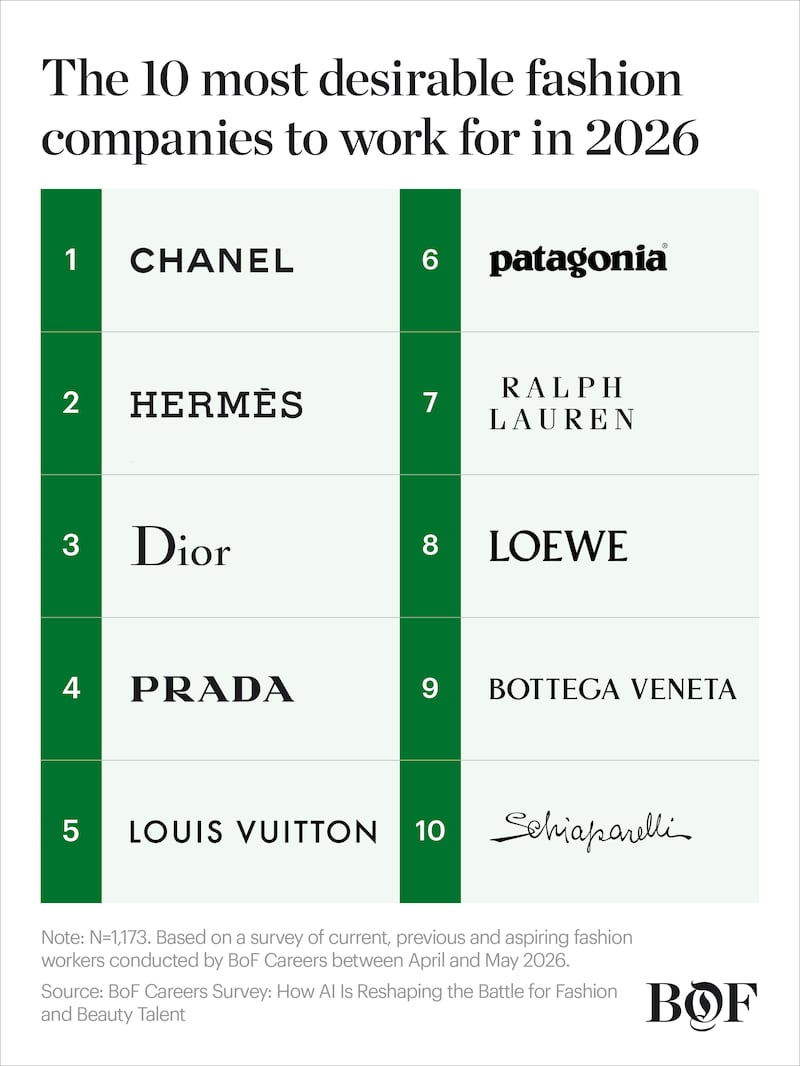
Chanel is the most desirable fashion company to work for in 2026, followed by Hermès and Dior. That verdict comes from 1,173 fashion professionals and aspiring workers across 93 countries — and the top three say as much about the industry’s mood as about the brands themselves. In an uncertain luxury market, respondents appear to have gravitated to the houses they see as the safest bets: those with the deepest heritage, steadiest finances and strongest reputations.
Tellingly, respondents rank pay among the things that matter most in an employer, yet the companies they most want to work for trade on prestige rather than the biggest pay packets. It is a gap the full BoF Careers report, How AI Is Reshaping the Battle for Fashion and Beauty Talent, explores in depth.
What draws talent from the outside, though, is not always what keeps them once inside. To weigh desirability against reality, this year’s ranking gives greatest weight to the people best placed to judge: those already working in the industry. “Insiders are the ones who have a better sense of whether it is truly a good place to work beyond what they see from the outside,” said Sheena Butler-Young, BoF’s senior correspondent for workplace and talent.
ADVERTISEMENT
For each of the top 10 companies below, BoF breaks down the findings into three parts:
The Macro Driver: the main reason respondents are attracted to the company.
The Talent Pull: why current fashion workers say they would jump ship and join the company.
Insiders’ Perspectives: a qualitative read drawn from recent reviews by current and former full-time employees published on Glassdoor and Indeed between December 2024 and May 2026, where available.
Chanel is the most desirable fashion company to work for in 2026, followed by Hermès and Dior. (BoF Design)
1. Chanel, The Independent Edge
The Macro Driver: Respondents say Chanel is shielded by private ownership and has “mastered the ‘long game’” — offering stability amid volatile trend cycles. The French maison is praised for “setting its own pace” to create culture.
The Talent Pull: The house is viewed as the “absolute pinnacle of luxury,” and current professionals see it as an elite career accelerator with highly competitive compensation and structured internal mobility.
Insiders’ Perspectives: Chanel employees praise the company’s financial health, competitive salaries, retail commissions, wellbeing benefits and collective pride in working for the brand. However, they flag heavy workloads and a slow, siloed bureaucracy lacking transparent career progression.
2. Hermès, The Humanity of Craft
The Macro Driver: Respondents say Hermès operates on a “values-driven philosophy” insulated from market pressures — offering scarcity and long-term strategy over “fast and furious” reactivity. The French house is praised for its “patient craftsmanship” and for refusing shortcuts to chase short-term profit.
The Talent Pull: Viewed as the “summit of corporate appeal,” Hermès is valued by professionals for its stable culture, fair compensation and mastery of craft. Respondents view its prestigious reputation as a springboard for career growth, with industry professionals acknowledging high employee welfare and long-term retention.
Insiders’ Perspectives: Hermès employees praise the brand’s loyalty, supportive peer culture and long-term employment stability. However, insiders also describe a traditional, political workplace where progression can feel “slow” while management quality varies.
3. Dior, The Jonathan Anderson Effect
The Macro Driver: Respondents position Dior as a brand in active evolution. The house is praised as “the gold standard of how to stay classic without ever feeling old,” while Jonathan Anderson’s influence has reinforced perceptions of the brand as a defining force in fashion’s next chapter.
The Talent Pull: Dior attracts professionals seeking proximity to scale, influence and creative momentum. Respondents describe the maison as operating “at the intersection of creativity and business strategy,” with touchpoints feeling “intentional and elevated.”
Insiders’ Perspectives: Employees acknowledge Dior’s collaborative teams and strong training infrastructure. Insiders also note, however, that the culture is often shaped by intense sales pressure and hierarchical management structures.
4. Prada, Italian Heritage and Cultural Dialogue
The Macro Driver: Prada is valued by respondents as a brand centring cultural and artistic commentary. The house is praised for being “ahead of [its] time” while maintaining a strong sense of Italian heritage and independence.
The Talent Pull: Prada attracts talent seeking creative development within a respected institution. Respondents describe the brand as “quietly intelligent and a little unexpected,” with many viewing it as “the dream job” owing to its reputation for challenging convention and its impact on long-term career value.
Insiders’ Perspectives: Employees reinforce Prada’s appeal as a prestigious employer, with many praising their coworkers, a luxurious work environment and competitive commission structures. However, insiders also point to stagnant base salaries and what they described as challenging management and intense operational pressures.
5. Louis Vuitton, The LVMH High-Performer
The Macro Driver: Respondents see Louis Vuitton as a brand that successfully balances heritage craftsmanship with reinvention. The French maison is praised for remaining “globally relevant without losing its core identity,” while operating at the intersection of “craftsmanship, innovation and strong business strategy.”
The Talent Pull: Louis Vuitton attracts professionals for its reputation as one of the most influential luxury brands. Respondents describe it as “an iconic institution where I can learn from the best,” with many drawn to its “entrepreneurial spirit” and commitment to innovation.
Insiders’ Perspectives: Louis Vuitton’s employee experience is characterised by strong local team cultures and a highly structured performance environment. Although colleagues are frequently described as supportive and collaborative, employees also report that heavy target-driven management and limited progression can make the organisation feel impersonal.
6. Patagonia, A Purpose-Driven Culture
The Macro Driver: Respondents cite Patagonia’s ownership structure and mission-led governance, in which climate impact takes precedence over conventional growth priorities. The brand is respected for its non-seasonal model, with durability and circularity at its core.
The Talent Pull: Perceived as a values-aligned employer, Patagonia attracts talent through a collaborative culture and credible benefits such as paid activism hours. Talent views the brand as a purpose-led career choice, with one respondent describing it as “a company that lives its values.”
Insiders’ Perspectives: Employees praise Patagonia’s supportive peer culture, work-life balance, and mission-led identity, with many highlighting strong people and environmental values as central to the experience. Some, however, point to rising tensions around workload, transparency and career stagnation following the recent ownership transition.
7. Ralph Lauren, The World-Building Advantage
The Macro Driver: Respondents position Ralph Lauren as a brand defined by clarity of vision and strong world-building, translating an “American dream” into a consistent, cross-category aesthetic. The brand is seen as enduring, with a consistent identity and storytelling.
The Talent Pull: Viewed as a stable, highly structured “heritage institution,” Ralph Lauren attracts talent through its reputation as a clear, long-term career destination with strong internal investment in people and technology. Respondents highlight it as a “forever brand and company,” positioning it as a secure environment for growth.
Insiders’ Perspectives: Ralph Lauren employees praise the company’s iconic brand heritage, supportive colleagues and collaborative spirit. However, insiders also report that a positive culture coexists with limited opportunities for career progression and outdated systems.
8. Loewe, The Pull of Artistic Experimentation
The Macro Driver: Respondents perceive Loewe as a heritage house that thrives on creative disruption, combining exceptional craftsmanship with a playful, “unpredictable” spirit and a strong artistic identity.
The Talent Pull: Loewe attracts professionals seeking creative freedom within a globally respected luxury maison. Many report being drawn to its reputation for empowering people, encouraging experimentation and preserving a sense of “childlike creativity and curiosity.”
Insiders’ Perspectives: Loewe employees say they thrive in a prestigious, high-energy environment marked by strong team camaraderie and momentum under the LVMH umbrella. However, store staff members say they frequently experience intense pressure from ambitious sales metrics alongside unpredictable retail schedules and high turnover rates.
9. Bottega Veneta, The Power of Technical Prowess
The Macro Driver: Bottega Veneta is valued by respondents largely for its “product purity” and craftsmanship — with many drawn to its reputation for “real savoir-faire.” The brand is also praised for its “artistic integrity.”
The Talent Pull: Bottega Veneta attracts professionals who are passionate about technical excellence — with one respondent highlighting its “advanced and considered approach to leather development and specialised manufacturing.”
Insiders’ Perspectives: Bottega Veneta employees praise the lucrative commission structures, elite brand prestige and strong corporate backing from the Kering Group. However, insiders also report high operational stress and inconsistent store management.
10. Schiaparelli, An Artistic Vision Unleashed
The Macro Driver: Respondents position Schiaparelli as a maison that embraces creative experimentation. The brand is praised for treating “every collection like a masterpiece” while remaining rooted in craftsmanship.
The Talent Pull: Schiaparelli attracts professionals seeking creative freedom within a distinctive house defined by “pure expression” and “art for art’s sake,” with many drawn to its strong reputation for storytelling, avant-garde design and intimate, collaborative teams.
Note: Schiaparelli did not generate enough reviews on Glassdoor and Indeed to populate the Insiders’ Perspectives section.
Respondents identified the three companies they would most like to work for in fashion and selected up to three reasons for their choices from the following criteria:
Company values and culture
Pay and compensation
Benefits and perks
Training and learning opportunities
Career progression opportunities
Employer brand and industry reputation
Innovation and technology (including AI)
From April to May 2026, BoF received 1,173 complete responses from participants across 93 countries, representing a range of seniority levels and age groups. Of these, 58 percent were current fashion employees, 27 percent were aspiring fashion professionals and 15 percent were former fashion workers. Current workers represent companies such as Balenciaga, Burberry, Gap, H&M, Moncler, Nike, Uniqlo, Valentino and Zara, among others.
In this second edition of the ranking, our team of analysts updated the survey methodology to better reflect the views of current fashion employees, former fashion workers and aspiring fashion professionals. Conglomerates are also no longer included as possible answers, to focus the ranking on brands. Because these changes affect how the ranking is built, this year’s top 20 is not directly comparable with our 2025 list.
ADVERTISEMENT
To create the ranking, each company was assigned a score based on how often it was selected by respondents and whether it was chosen as a first, second or third preference. Responses were then weighted to reflect professional experience: current fashion workers received a weighting of 1, former fashion workers 0.75 and aspiring fashion workers 0.5. Unless otherwise stated, findings are based on all available valid responses for each survey item. Partially completed questionnaires were included where respondents had provided relevant answers; for analyses comparing responses across multiple questions, only respondents who answered all relevant items were included. The survey did not ask respondents about preferred company size, so the ranking skews towards larger companies.
The volume of employee reviews behind each Insiders’ Perspectives varies by company, so those findings are thematic rather than statistically representative. Where we did not have enough responses to consider, the Insiders’ Perspectives section was not completed.
Disclosure: LVMH is part of a group of investors who, together, hold a minority interest in The Business of Fashion. All investors have signed shareholders’ documentation guaranteeing BoF’s complete editorial independence.
L’Oréal Paris, Dior Beauty and Charlotte Tilbury topped the list as 296 beauty professionals and aspiring workers from across 53 countries tell BoF Careers where they dream of working — and what’s pulling them there.
Fashion and beauty workers are AI optimists — but their employers aren’t keeping up. BoF Careers’ annual survey of 2,926 professionals reveals a widening gap between what talent expects and what the industry delivers.
Workers staged fresh demonstrations in Dhaka Thursday, forcing factories to suspend operations despite government promises to raise wages before the end of the year.
Just a few years ago, commentators were declaring the brand as past its peak amid multiple ownership changes and a broader streetwear cooldown. Today, consumer tracking metrics shows domestic sales and youth market share is rebounding strongly.