Agenda-setting intelligence, analysis and advice for the global fashion community.
Agenda-setting intelligence, analysis and advice for the global fashion community.


Searching for sustainable fashion has never been straightforward.
Consumers looking to shop more responsibly are confronted with a maze of different claims — from “conscious” and “clean” to “plastic-free” and “natural” — often with little consensus over what those terms actually mean.
In theory, it’s an area where AI tools such as ChatGPT, Claude and Gemini can help. By digesting huge amounts of information from across the internet, they promise to provide shoppers with actual answers to their questions about which brands are right for them rather than just a list of links to read through.
These capabilities of large language models have more shoppers turning to them for guidance on their buying decisions In June, 41 percent of US consumers used generative AI for online shopping, according to an estimate by Adobe Analytics.
ADVERTISEMENT
“AI does affect consumer behaviour today,” said Dr Rebecca Beech, senior lecturer in marketing at Oxford Brookes Business School, whose research focuses on consumer behaviour, AI and sustainable consumption. “The extent to which it does depends on people’s digital literacy.”
AI has shortcomings that consumers may overlook. Large language models learn patterns from the vast amount of information they’re trained on, identifying associations between brands and the words most frequently used to describe them. They do not independently investigate companies or verify environmental claims. The information they ingest may also come from blog posts or comments on forums such as Reddit that aren’t always accurate.
To understand what AI platforms are actually recommending to shoppers looking for sustainable fashion, BoF worked with Quilt AI to analyse the responses from ChatGPT, Claude and Gemini when prompted to suggest “clean,” “plastic-free” and “sustainable” brands.
The results reveal a mixed landscape.Patagonia, known as a leader on sustainability, emerged as the consensus winner across all three searches, recommended between 96.7 and 100 percent of the time. But Uniqlo also appeared among recommendations for plastic-free brands, despite many of its signature products, including Heattech and AIRism, relying heavily on synthetic fibres such as polyester that are essentially forms of plastic.
The data suggests consumers should treat AI-generated recommendations as a starting point rather than a definitive ranking of sustainability performance.
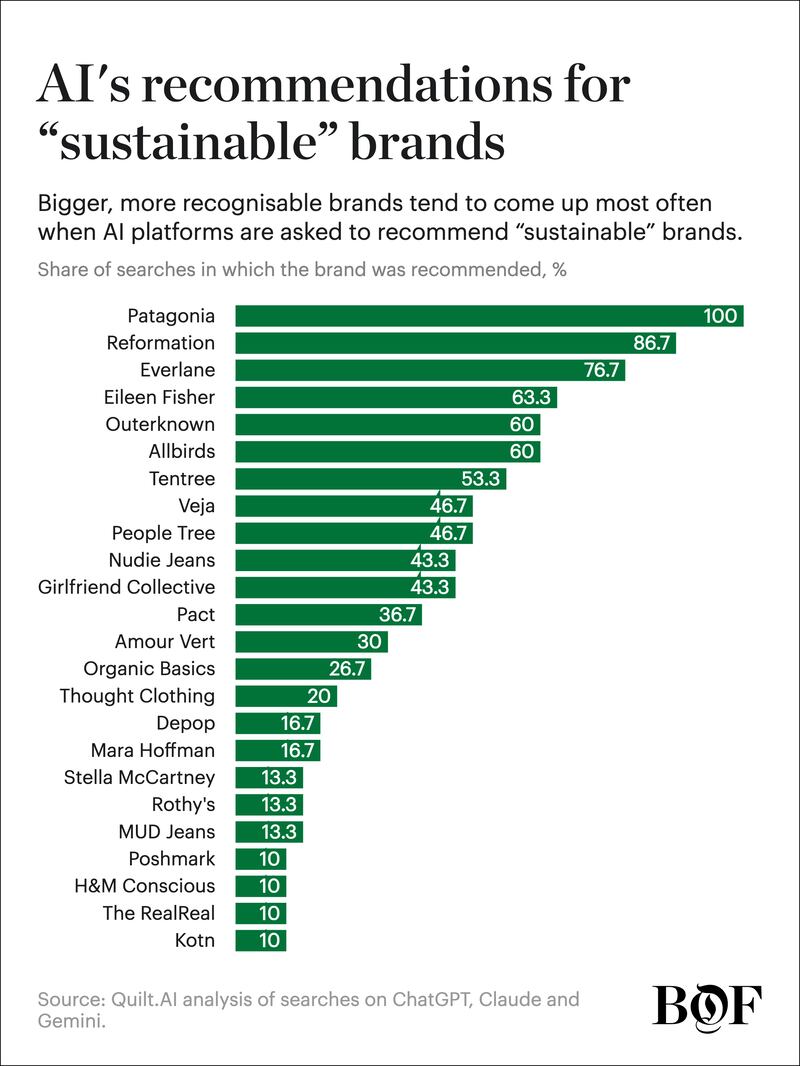
Overall, the AI platforms did tend to recommend brands known for prioritising sustainability or natural materials. Reformation and Everlane, both of which have made sustainability part of their selling points to consumers, were consistently among the top performers.
But the findings also indicate how LLMs simply respond to the language used in a prompt and the associations they have learned between particular brands and those terms.
Searches for “sustainable” brands generally favoured larger, more recognisable names, such as Everlane, Veja and Girlfriend Collective, that have spent years building sustainability into their broader public positioning, for example.
ADVERTISEMENT
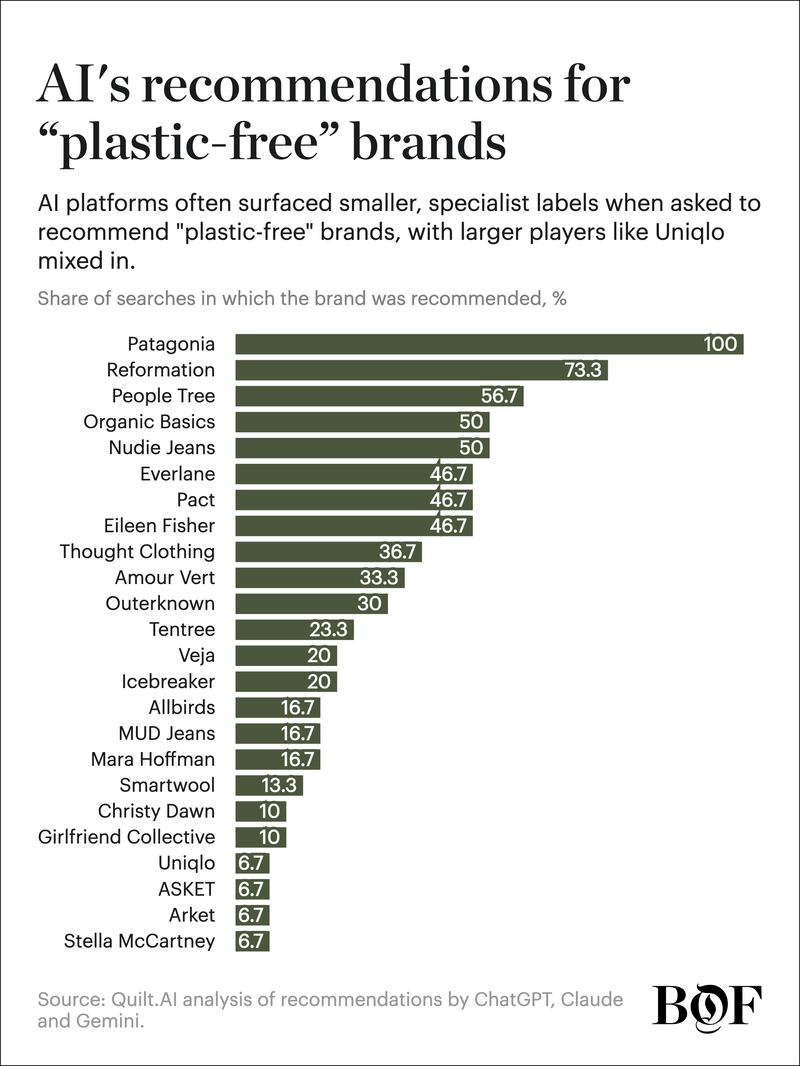
By contrast, searches for “plastic-free” surfaced a group of smaller, specialist labels, including People Tree, Organic Basics, Nudie Jeans, Icebreaker and Thought Clothing, whose identities are closely tied to natural fibres or specific material choices.
“Clean” produced the least consistent results of the three searches. After Patagonia, which was recommended nearly 100 percent of the time, no other brand appeared in more than 56.7 percent of responses, with Pact emerging as the second-most frequently suggested label.
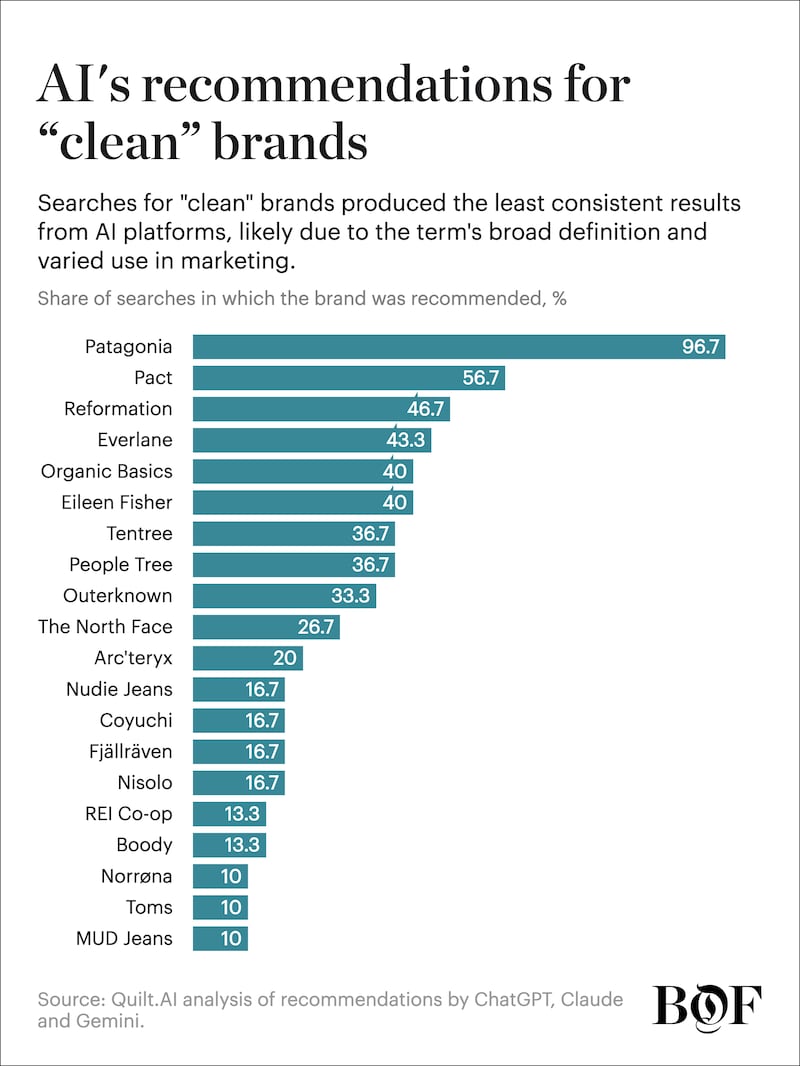
Noticeably, simply changing the wording of a prompt meaningfully changed the brands recommended. Reformation was suggested in less than half of “clean” searches but appeared in nearly nine out of 10 “sustainable” searches.
The real question is whether the AI’s recommendations can be considered reliable. Part of the challenge lies in the language itself. Unlike “plastic-free,” which has a relatively clear meaning, terms such as “clean” and “sustainable” have no universally agreed definition. That leaves LLMs to infer what those concepts mean before recommending brands.
“There is no agreed-upon definition of sustainable,” said Ken Pucker, professor of sustainable business dynamics at Tufts University’s Fletcher School and former chief operating officer of Timberland. “That inherently makes such a search challenging.”
According to Pucker, the recommendations face three fundamental limitations. First, the associations AI is making between brands and the search terms are often based on what the companies themselves are publishing on their websites and social channels or telling media outlets. It’s not independently verified data.
Second, the underlying information available to AI models is often incomplete. While sustainability reports may appear to offer a richer source of information, much of the data published by brands remains unaudited and self-reported, while even audited disclosures frequently cover only a fraction of a company’s total environmental footprint.
“The rankings are only going to be as good as the inputs,” he said. ”And the inputs are incomplete, in some cases inaccurate or aged and unaudited.”
ADVERTISEMENT
The rankings can also be influenced by scale and visibility. Smaller companies with strong sustainability credentials may receive relatively little attention simply because they generate fewer online mentions, while globally recognised brands that have spent years positioning sustainability as part of their identity are far more likely to dominate recommendations.
That dynamic is reflected in the Quilt analysis. Patagonia — arguably the fashion industry’s most recognisable sustainability brand — topped recommendations regardless of whether users searched for clean, plastic-free or sustainable fashion, while several lesser-known sustainability-focused labels appeared only sporadically despite specialising in many of those same principles.
Rather than measuring which brands perform best environmentally, today’s LLMs appear more likely to reflect which brands have become most strongly associated with sustainability in the public conversation.
With more consumers turning to ChatGPT, Claude and Gemini for shopping advice, the way these systems categorise brands is becoming increasingly influential.But as fashion brands optimise their websites and marketing for generative engine optimisation, or GEO, their consistent use of terms such as “sustainable,” “natural” and “clean” may strengthen those associations across AI systems over time, whether or not the facts back them up.
Beech says a growing divide is also emerging between shoppers who treat AI as a quick recommendation engine and those who use it as the starting point for deeper research. Someone searching for “sustainable fashion brands” may receive a list based largely on widely recognised sustainability narratives.
A more digitally literate user, however, is more likely to interrogate those recommendations further, asking about materials, supply chains, certifications or independent verification before making a purchasing decision.
Ultimately, the responsibility for judging sustainability still falls on consumers. While LLMs may save shoppers from trawling through pages of search results, they cannot yet replace the critical judgement required to assess whether a brand’s environmental claims hold up.
The material has become a lightning rod on social media as shoppers reject synthetics and seek out clothes made from natural fibres. The reasons go beyond consumers viewing polyester clothing as cheap or poor quality.
As shoppers increasingly turn to ChatGPT and Google's Gemini for product recommendations, retailers are racing to appear in chatbot results while resisting efforts to cede customer data that underpin online sales.
Algorithms are increasingly shaping how luxury clients shop, redefining their relationships with brands, according to BoF Insights and McKinsey’s report ‘Face to Face With Luxury Clients.’

Shayeza Walid is Senior Editorial Associate covering Sustainability at The Business of Fashion. She reports on fashion's environmental impact, climate accountability, supply chain and labour issues. Based in London, she also contributes to BoF's Global Markets and UK coverage.
Loading recommended reads…
The New York Times photographer and style columnist joins Imran Amed on The BoF Podcast to discuss why practice makes permanent, the blind spot he had to admit to himself and why the style he looks for is meant to feel within reach.
In Panipat, 1 million tons of used clothing a year are turned into products for global brands, but dangerous machinery and few safeguards mean life-changing injuries are common
The struggles of Nanushka and Coperni expose the challenges of turning a promising label into a sustainable business, even after successfully building a global customer base and distinctive visual identity.
What to keep and what to change when a brand changes designers? Pierpaolo Piccioli’s brief stint at Balenciaga and Kering’s effort to course correct by bringing in Martine Rose offers learnings for houses seeking creative renewal.