Agenda-setting intelligence, analysis and advice for the global fashion community.
Agenda-setting intelligence, analysis and advice for the global fashion community.

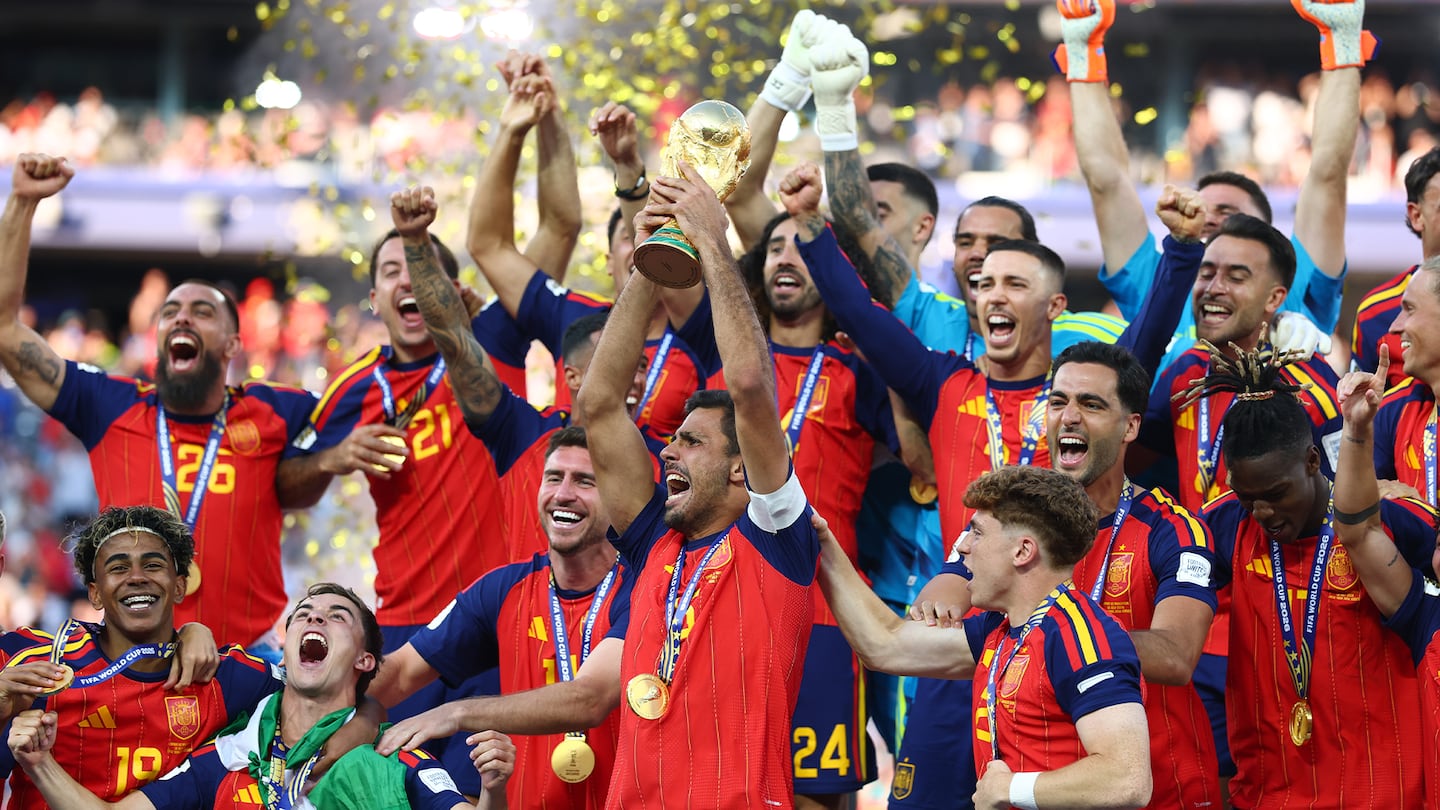
While Spain was undeniably the biggest winner of this year’s FIFA World Cup, fashion was not far behind.
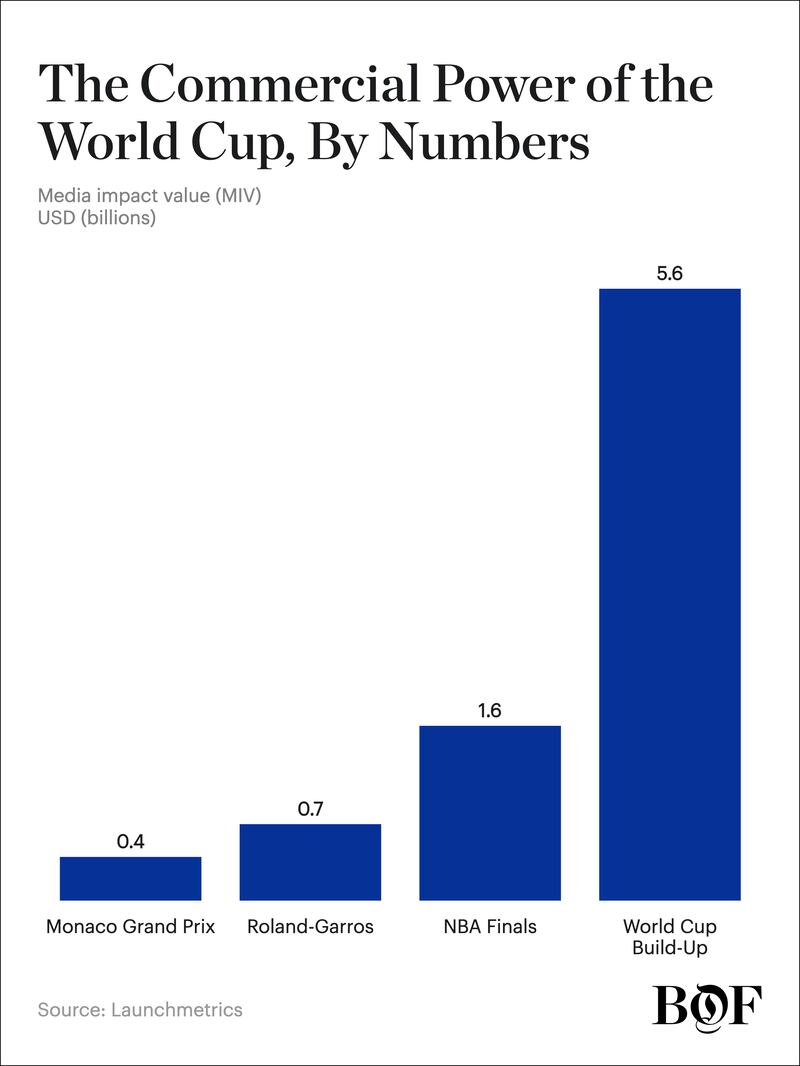
The five-week-long tournament was the industry’s biggest sports marketing spectacle since the LVMH-sponsored Paris Olympics in 2024. There were endless opportunities for brand-building moments, and not just for the sportswear labels seen on the pitch like Adidas and Nike.
As usual, Louis Vuitton encased the World Cup trophy in a giant monogrammed trunk while beauty giant Unilever, FIFA’s official personal care sponsor, had 35 of its brands sponsoring activations worldwide. To boot, with the tournament’s footprint centred heavily on the 11 US venues, brands also benefitted from having the world’s largest luxury market as the backdrop for the year’s most talked-about sporting event.
“As a global cultural focus, it is absolutely number one and nothing else matches its scale,” said David Skilling, founder of Faze 3 Sports, a newsletter focused on the business and culture of sports.
ADVERTISEMENT
Skilling adds that marketing around the World Cup is a highly competitive, expensive endeavour that typically could only be pursued seriously by large brands. Nike and Adidas were at the forefront, capitalising on the massive hype in the days leading up to the tournament. Nike’s “Rip The Script” campaign, a six-minute-long ad that bridged Nike’s sponsored football athletes and mainstream pop culture icons that ranged from Travis Scott to Kim Kardashian, was particularly consequential, generating $60.7 million in media impact value (MIV), according to Launchmetrics.
By blending sport and culture at large, Nike generated massive — and much-needed — brand heat. It also allowed them a win over Adidas, which also tapped non-sports celebrities like Timothée Chalamet and Bad Bunny to star in its five-minute “Backyard Legends” commercial, which generated $22.4 million in MIV.
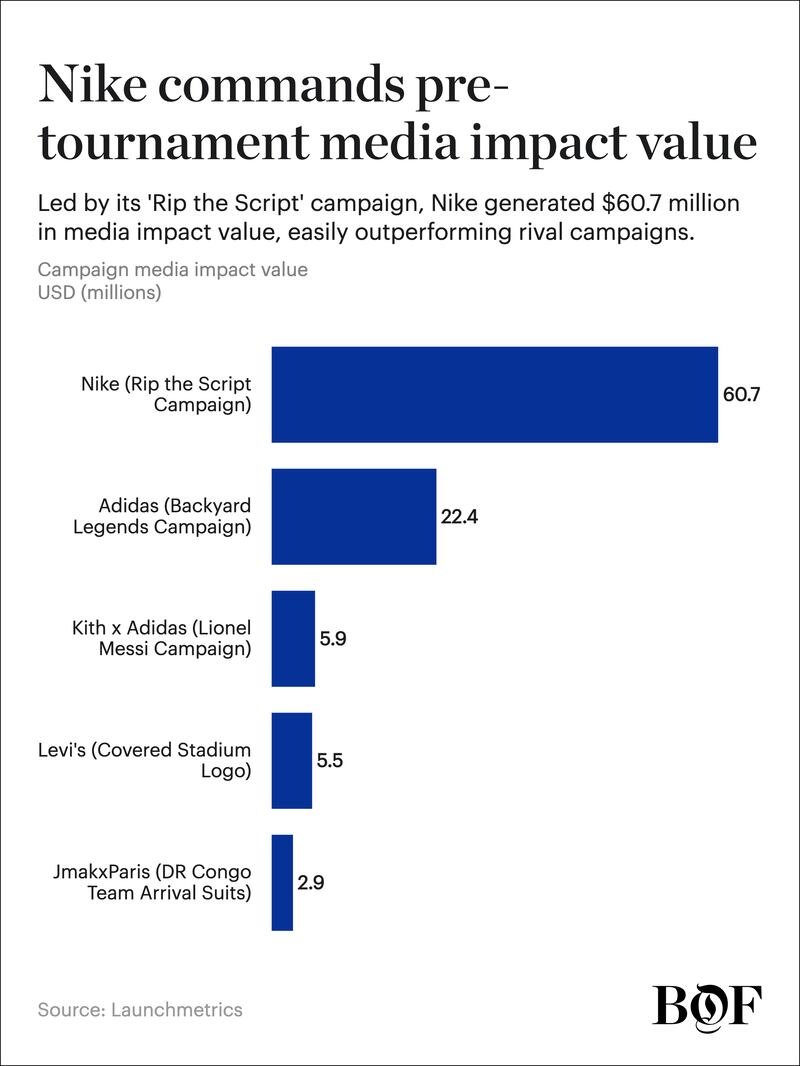
Yet outside of the grandiosity of these global sportswear giants, brands like Levi’s managed to generate over $5.5 million in MIV by creating a reactive marketing moment that flipped FIFA’s censorship of unofficial sponsors on its head. To comply with FIFA’s strict rules to obscure any stadium signage outside of key sponsors, the brand wrapped the sign of Levi’s Stadium so tightly so the shape of its recognisable logo still remained visible.
“Everybody still knew it was a Levi’s Stadium and then the fact that they changed all their social media handles to the same covered-up logo, and even had stores around the US do the same … was an absolute genius reactive marketing strategy,” said Skilling.
Yet, even though Nike may have garnered the most measured engagement for a 12-week marketing campaign that hit the intersection between football and pop culture, Skilling believes Adidas emerged as the winner on the pitch. That’s because as the premier official FIFA Partner, Adidas has overwhelming visibility within the actual games, appearing on everything from the soccer ball to official referee uniforms. And out of the 48 teams that participated in the World Cup this year, Adidas dressed 14 teams to Nike’s 12. That narrow lead not only resulted in two Adidas-backed federations duking it out in the final, but also drove explosive US search interest for its international team jerseys, according to Trendalytics.
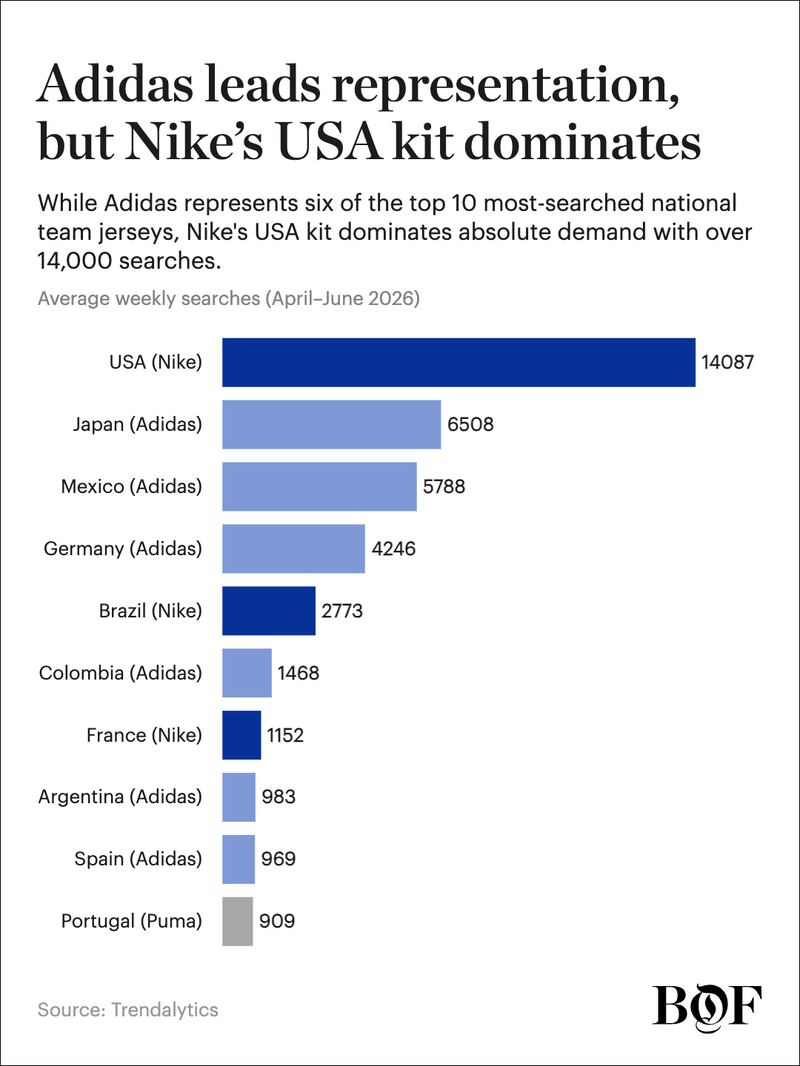
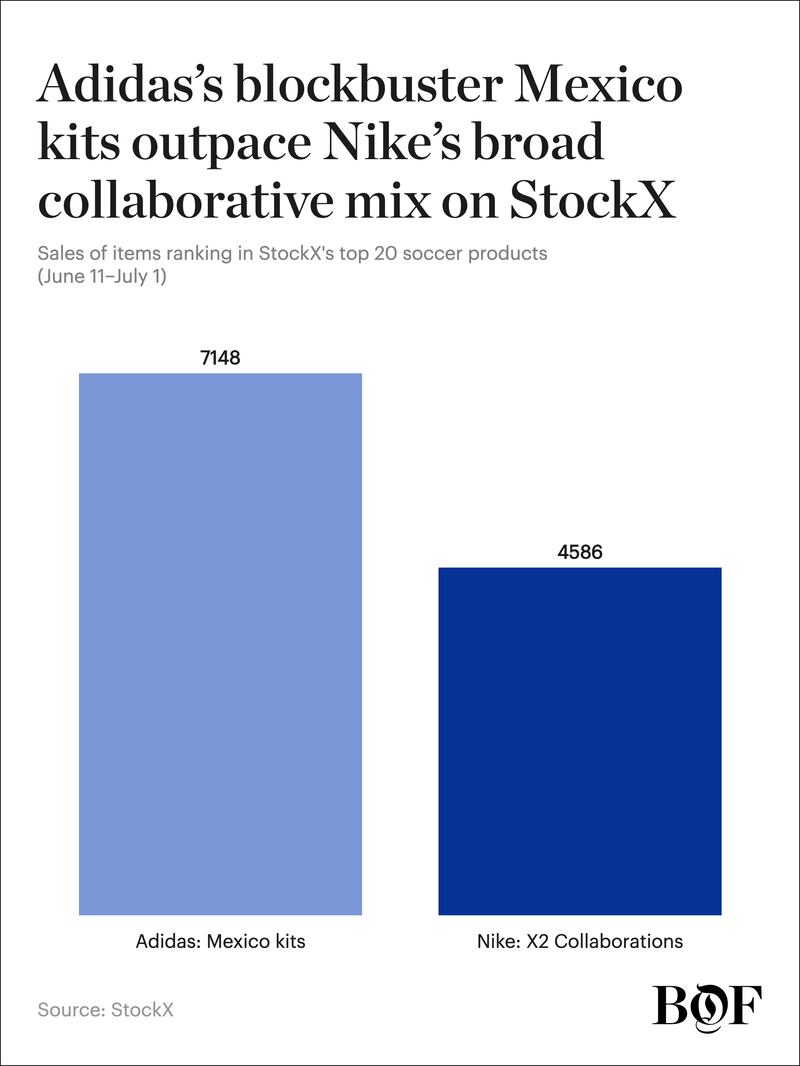
But while Nike’s USA kit naturally gained traction in the World Cup’s most populous host nation, Adidas’ official Mexico merchandise also resonated. According to StockX, the top 20 “soccer” products sold between June 11 and July 1 included over 7,000 sales of Mexico-branded Adidas merchandise. Nike, on the other hand, drove demand through collaborations, placing items from Patta, the Virgil Abloh Archives, and Travis Scott on StockX’s list. Skilling believes the wavy stripes on Team USA’s jersey made it particularly attractive to collectors, but also flagged that the excitement over Mexico’s tournament apparel likely comes from a history of a stronger passion for the sport in the country.
For both brands, lifestyle-coded football apparel paid off heavily. According to StockX, the top two best-selling apparel releases within the first six months of 2026 were both Nike soccer jerseys: a reissued 2005/06 Barcelona Ronaldinho jersey and a Team England jersey designed by British streetwear label Palace for Nike’s World Cup-themed “X2” collection. Similarly, Adidas released World Cup collaborations with designers like Willy Chavarria and brands such as Bape and Brain Dead. The Mexican singer Kenia Os notably stepped out in Chavarria’s Adidas collaboration during the opening ceremony for the games in Mexico City.
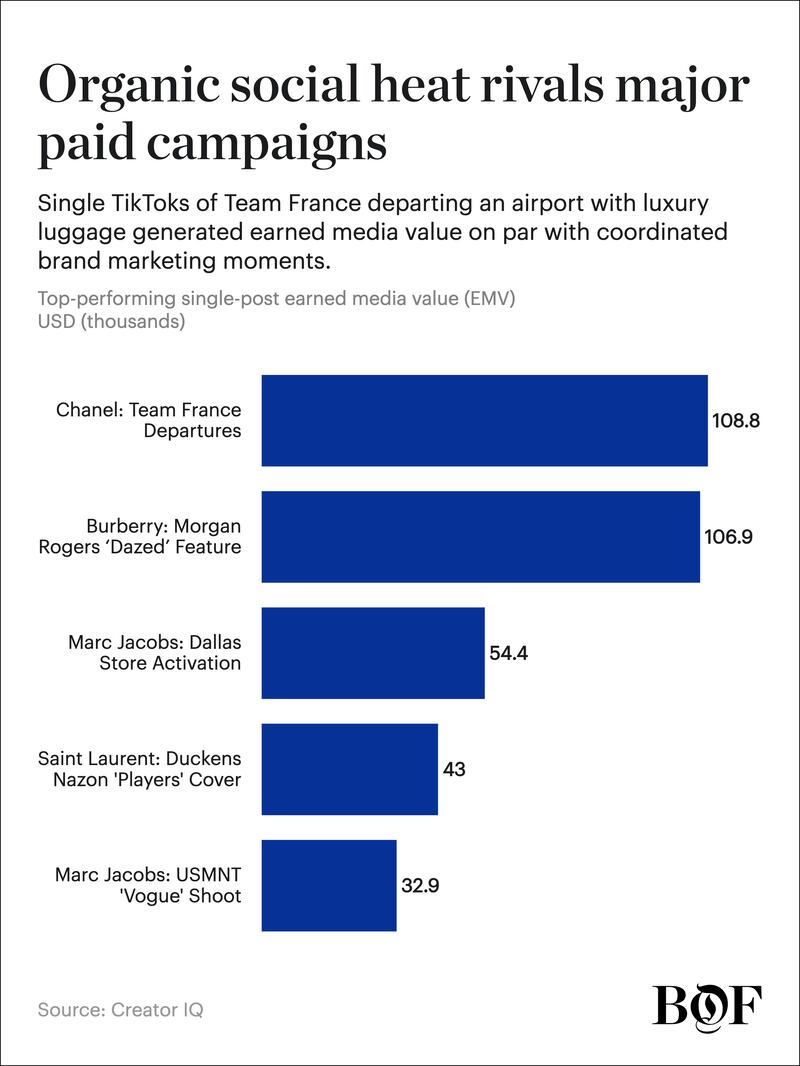
Yet while the battle for commercial products was dominated by the world’s two biggest sportswear brands, luxury labels benefitted from the players themselves. According to CreatorIQ, French footballers departing the airport with luxury bags to play their first game against Senegal earned more attention for brands such as Chanel, Louis Vuitton, Hermès and Bottega Veneta than planned magazine features in Dazed, Players and Vogue. Skilling added that at times, even for luxury brands, it’s challenging to engage directly with football players due to the biggest clubs tightly controlling how players dress — especially major ones like Real Madrid or Barcelona.
ADVERTISEMENT
“Soccer players show unique style in personal moments, but when representing the club, they must wear the designated partner brand,” said Skilling.
What likely comes next for fashion-football marketing is for brands to capitalise on the World Cup’s newly minted style stars.
Norwegian star Erling Haaland, for example, became a mainstream social media sensation over the past five weeks not for just his striking athleticism but also his charismatic personality off-field, as well as his signature man bun. Dolce & Gabbana, which inked an endorsement deal with Haaland in 2023, is an early winner there: Three days after his World Cup run ended, Haaland and his partner Isabel Haugseng Johansen attended the brand’s Alta Sartoria show in Sicily. Skilling flags the British footballer Djed Spence and the French national team defender Jules Koundé as two emerging style icons from this cycle.
Brands quick to identify moments that resonate with both casual observers and true sports fans are poised to win when the World Cup comes back around in 2030.
“Brands need to remember that partnerships must feel authentic to the sport,” said Skilling. “Brands wanting to enter the next World Cup must ask how they can add to the culture rather than take from it.”
Editor’s Note: Charts in this story were amended on July 20 for clarity.
After Argentina’s comeback victory over England in the World Cup, the competition will come down to two Adidas teams, giving the brand a variety of ways to capitalise on the biggest stage in sports.
Luxury companies need to adjust their strategies to tempt more men to buy handbags, Bloomberg’s Andrea Felsted writes.
A blockbuster spot featuring superstars from Kylian Mbappé to Kim Kardashian is just part of the US sportswear giant’s huge bet on a blend of football and culture to connect with consumers on its home turf and beyond as it seeks to use the biggest World Cup in history to reignite brand heat and sales.

Lei Takanashi is a Correspondent at The Business of Fashion (BoF). He is based in New York City and covers menswear, streetwear, young consumer trends, and the intersection between fashion and culture.
Loading recommended reads…
Both brands saw sales in China jump more than 30 percent for the quarter ending in September — the same period when labels from LVMH and Kering reported double-digit declines in the country.
Sales were up 4.8 percent compared to a year earlier, a modest increase than was experienced in 2025.
Quarterly sales were slightly above expectations, despite a small deceleration in China, where the British fashion house performed better than rivals.
The sportswear giant has much to explain at its first capital markets day in almost a decade as it works to reignite demand and restore investor confidence.