Agenda-setting intelligence, analysis and advice for the global fashion community.
Agenda-setting intelligence, analysis and advice for the global fashion community.



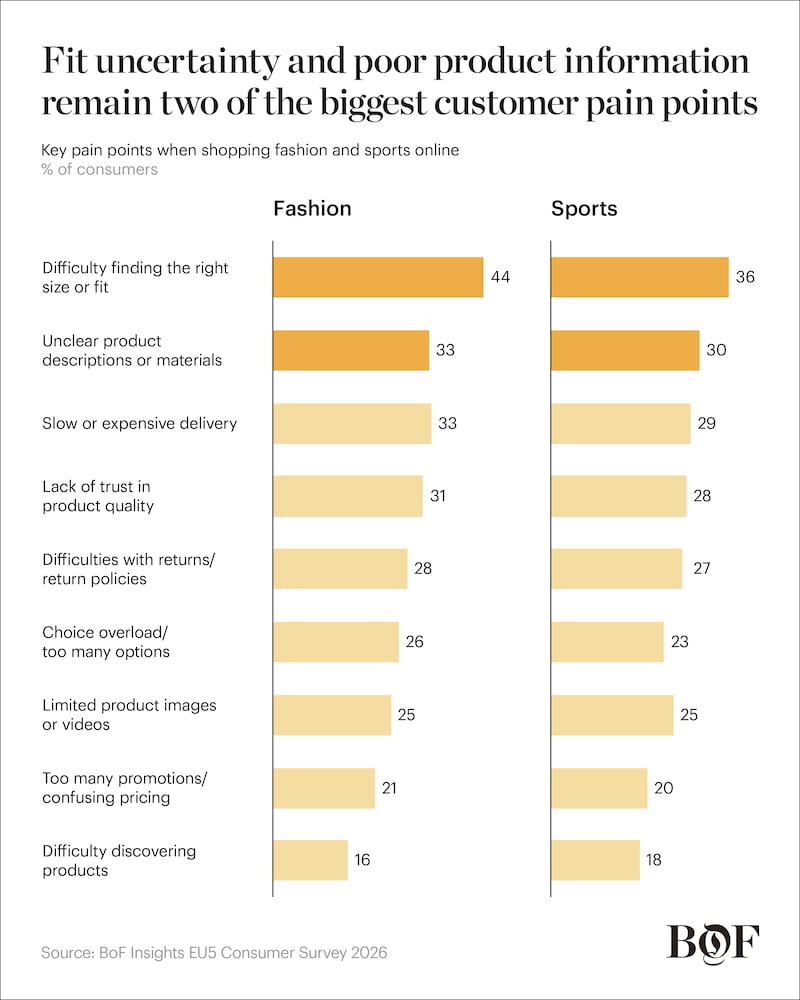
The problems holding back e-commerce sales are not new ones. Online fashion and sports shoppers still struggle to find the right size and trust what they read about a product — and the impact can be significant. One in five European consumers say they last abandoned an online fashion or sports purchase due to lack of adequate product information, according to a survey in BoF Insights’ latest report “Inside Fashion & Sports E-Commerce” produced in collaboration with Amazon Fashion & Sports.
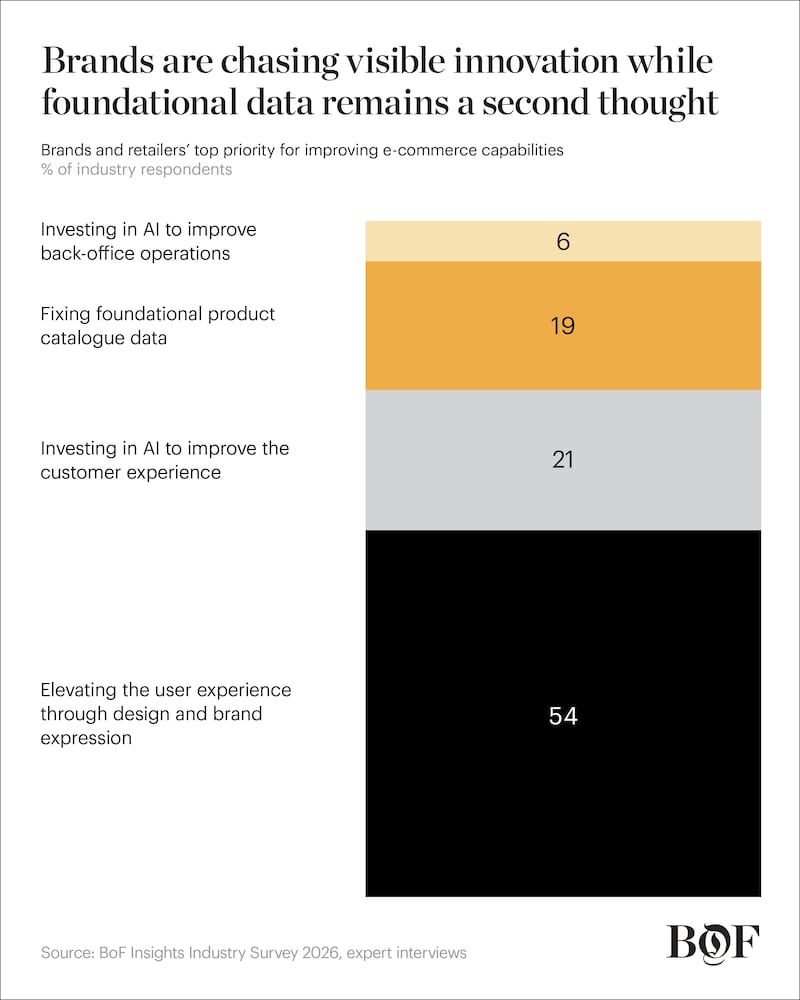
But only nineteen percent of brand and retailer leaders surveyed said fixing foundational data is their top priority, while 54 percent are concentrating their efforts on UX and brand expression. AI investment follows.
Meanwhile, critical confidence barriers — around fit, materials and quality — remain customers’ top two pain points when shopping online.
“So many brands are tempted to just jump in [to adopting AI], but you can’t skip over cleaning up your data first,” said retail and consumer expert Stacey Widlitz. “That is one of the big warnings: don’t be tempted by all the tools out there if you don’t have your data clean and organised,” she said.
Beyond creating customer confidence, other critical parts of the e-commerce experience such as search and personalisation also rely on clean, structured product data. To be sure, UX and brand expression still matter in delighting customers, but they can only go so far when the underlying product information is weak.
For example, Swiss outdoor brand Mammut is holding off on advanced technology like AI-driven recommendations and virtual try-on until its foundations are solid. “We don’t want to build a house on a broken foundation,” said Anne Ernevi, the brand’s head of e-commerce and digital business. That starts with plain language: after the brand’s customer research found shoppers were confused by technical specifications, Mammut replaced its waterproofing rating with a simple one-to-six scale. The brand also matches content to the product, so a technical alpine climbing jacket gets full photography and video while a basic T-shirt gets a simpler page.
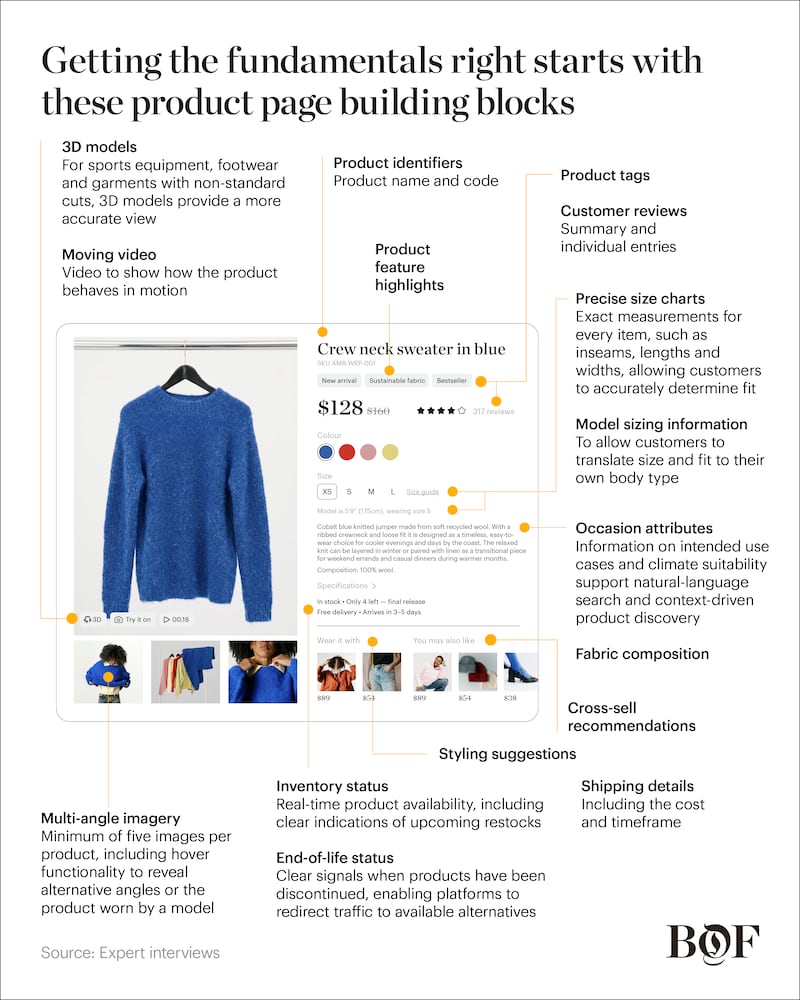
Before investing in advanced capabilities, brands and retailers need to take an honest look at where they are, and ensure the basics feel effortless first. Rather than competing for budget, AI can also offer some solutions to brands and retailers’ product data gaps:
Scaling Visual Asset Production
Brands can now take a single product image and generate videos, 3D models and multi-angle variations across colourways. Flat imagery can be extended into contextual scenes. This dramatically expands catalogue coverage without traditional production costs and enables richer product storytelling.
Brands selling on Amazon can use generative AI tools to complete product information like descriptions and attributes. Amazon also provides AI tools that help brands generate lifestyle imagery to further enrich their product pages and product-scanning tools to create 3D models.
Standardising Visual Consistency
Generative AI cleans fragmented product imagery at scale by standardising backgrounds, unifying product orientation and reducing visual noise. The result is a more comparable, professional catalogue without manual intervention.
For example, Decathlon worked with AI image-editing platform Photoroom to standardise product imagery across categories. The initiative reduced the team’s workload fourfold while cutting the cost per image by 99 percent, according to Photoroom.
Enriching Copy and Extracting Attributes
AI rewrites sparse product descriptions into structured copy and extracts implicit attributes from basic inputs and customer reviews by inferring properties or intended use and converting them into structured data.
Depop introduced a generative AI listing tool in late 2024 that creates product descriptions from a single image. Once sellers upload a photo, the system generates a title, category, colour, hashtags and a description in the platform’s native tone. In early testing, 50 percent of eligible users adopted the tool, signalling clear demand for automation.
Auditing Catalogues
Rather than slow manual audits, AI can continuously scan product catalogues for gaps, flagging missing imagery or incomplete data and triggering alerts before launch, protecting early sales momentum.
The enterprise marketplace platform Mirakl automates product listing quality control. Before a product goes live, the technology validates it against catalogue standards, flags any errors and guides users through the required corrections.
Product data is only half the picture. Brands also sit on customer data such as sizing preferences, browsing behaviour, purchase history and returns patterns. The problem is it rarely talks to itself.
“Many retailers and brands still have disjointed data sets. Their online experience, their e-commerce store, tends to lack some of the data points that their CRM or enterprise management system has in the backend, and their manufacturing team has different data points from their online websites,” said technology analyst Juozas Kaziukėnas.
When these signals are connected, brands can build a much sharper picture of individual customers: what fits them, what they want next, what will make them return. The more a brand understands its customers, the better its recommendations become. Better recommendations drive higher conversion and fewer returns, and that compounds over time.
For brands selling through retailers, marketplaces like Amazon can provide access to product-level traffic and conversion data, key search terms and returns analytics, including why products were sent back — data most brands would find challenging to generate at this scale on their own.
BoF Insights is The Business of Fashion’s in-house consultancy. We partner with leading fashion and beauty brands and investors to help them sustainably grow for the long term. Get in touch to find out how we can support your business.
The brands earning shopper attention online are investing in content and cultural moments that entertain before they sell, finds BoF Insights and Amazon Fashion & Sports’ latest report ‘Inside Fashion & Sports E-Commerce.’
Join us for our next BoF LIVE on Wednesday, Sept. 16, at 15:00 BST / 10:00 EDT as the authors of our latest report ‘Inside Fashion & Sports E-Commerce’ unpack what really matters to customers when shopping online today.
This new flagship report reveals that fashion and sports leaders are chasing what’s new in e-commerce while fundamental challenges remain unresolved. Based on surveys of 10,000 consumers and 150 senior leaders across the UK, Germany, France, Italy and Spain, it shows brands and retailers where to focus to innovate without losing sight of what drives success.
Loading recommended reads…
In this week’s High Margin, a search for images that cut through our visual fatigue — with leads from M/M Paris, Ferdinando Verderi and stylist Emilie Kareh. Plus: Tod’s designer exit; Burberry’s resilient sales.
The producer price index rose 6.5% from October 2025, an acceleration from the prior month, according to Bureau of Labor Statistics data out Friday. On a monthly basis, the PPI increased 0.3%.
The creative director and strategist joins Imran Amed on The BoF Podcast to discuss the evolution of his career, the realities of shaping artist narratives and why long-term collaboration outperforms short-term marketing.
The former Nvidia CEO was central to an AI boom that has propelled the US stock market and fueled the country’s unmatched luxury spending. After his exit, nobody is sure what happens next.