Agenda-setting intelligence, analysis and advice for the global fashion community.
Agenda-setting intelligence, analysis and advice for the global fashion community.


Dear BoF Community.
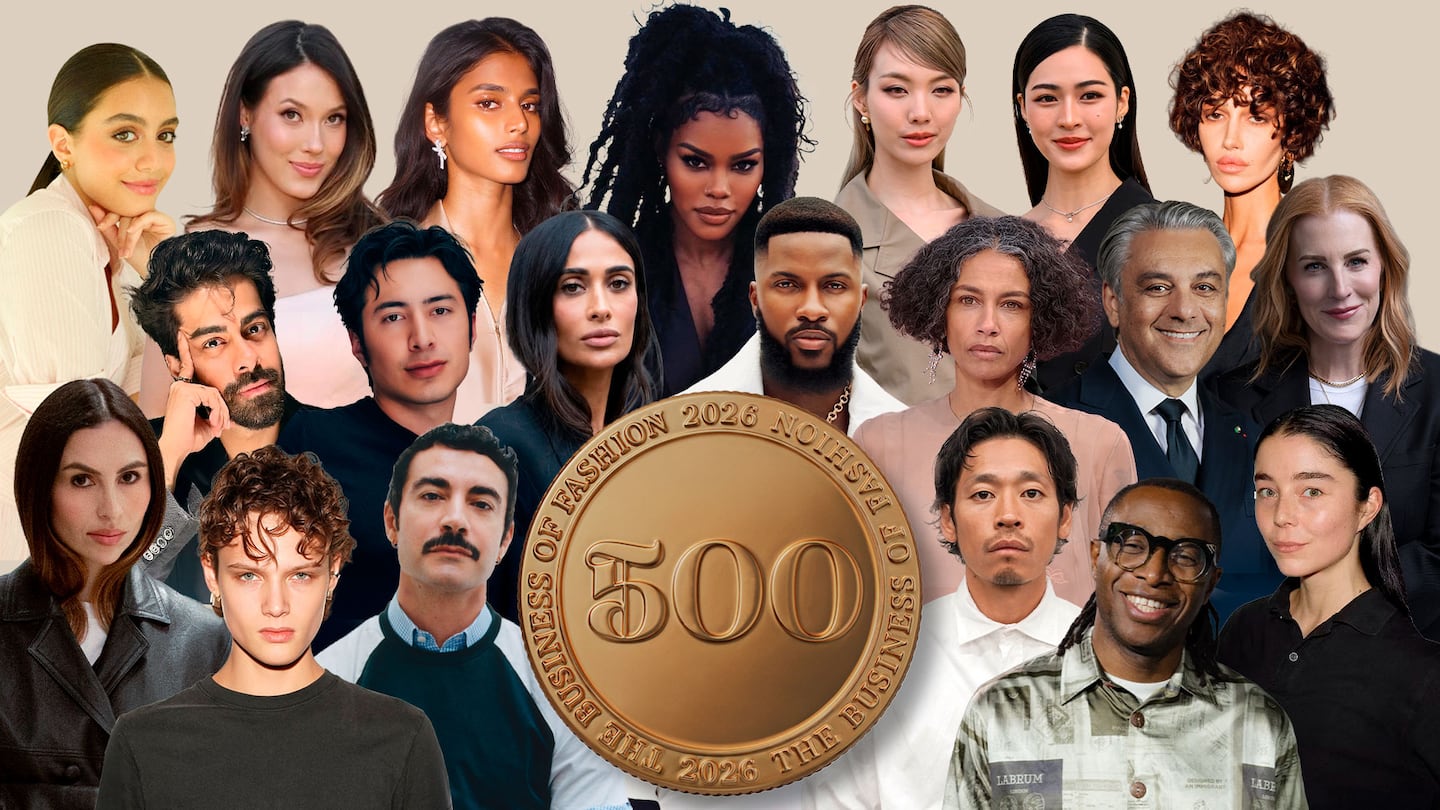
Today, we are excited to introduce you to The BoF 500 Class of 2026.
What started in 2013 with an index of 500 people shaping fashion has this year grown into a community of 1,713 people from around the world, who come together for The BoF 500 Gala, an annual reunion held at the height of Paris Fashion Week to connect with each other and welcome our new members.
The process for selecting our new members is both an art and a science, conducted over the course of several months based on nominations received from existing BoF 500 members and the BoF team. This year, we sifted through 445 names across 8 distinct categories: Designers, Executives, Models & Muses, Entrepreneurs, Catalysts, Media, Retailers and the Creative Class. For each nominee, we do deep research and follow-up phone calls to inform hours of debate and discussion, category by category, to identify 100 people shaping the fashion industry of today and tomorrow.
We consider each nominee’s leadership, creativity, innovation and social impact, but most of all we look for inspiring stories from people whose work is genuinely pushing the industry forward.
The BoF 500 Class of 2026 — coming from every corner of fashion and every corner of the world. This year, we are pleased to include new entrants not just from the world’s traditional fashion capitals, but also from Finland, Sri Lanka, Tanzania and Uganda, nationalities that are represented for the first time.
As the new class comes together, it is also a valuable learning opportunity, providing an annual snapshot of how the fashion system — and worlds it intersects with — is changing.
So, what have we learned about the industry from this year’s new entrants?
Amid a difficult market, fashion businesses have turned to new leaders to chart a different course, creatively and commercially.
Luca de Meo is symbolic of this shift, as the first outsider to run Kering. In his first year in the role he has made a series of decisions that are starting to put his vision into focus. The jury is out on how, when and if he will deliver a much-anticipated turnaround at the French group, but there’s no doubt De Meo is one of the most important new leaders in fashion.
And while Silvana Armani and Leo Dell’Orco are the guardians of the late Giorgio Armani’s legacy, Dario Vitale is likely to help catapult Emporio Armani back into the fashion conversation, following on his sexually-charged Versace debut which still has fashion insiders talking one year later. His first show for Emporio, expected in February 2027, will be one of the most anticipated fashion moments in the next 12 months.
Meanwhile, Hillary Super is steering one of the most closely watched turnarounds in American fashion at Victoria’s Secret, doing what many thought was impossible. Last month, the company announced its fifth consecutive quarter of positive comparable sales growth.
While the attitude towards diversity and inclusion may have stalled in some quarters, fashion still understands that imagery has the power to shape perceptions and definitions of beauty.
Matthieu Blazy’s Chanel is leaning into diverse casting with prime placements for Bhavitha Mandhava and Stephanie Cavalli. Mandhava was the first Indian model to open a Chanel show and Cavalli has become Blazy’s nod to age representation.
Based in Uganda, Joram Muzira, who joins this year’s class as a Catalyst, has spent more than a decade scouting South Sudanese and refugee faces across East Africa for international agencies.
And, the British rapper Vincenzo Nischal Camille Bhatia of Punjabi and Algerian descent, better known as Fakemink, walked Demna’s debut Gucci ‘Primavera’ show in Milan in February 2026, crystallising his status as a popular Gen Z fashion plate.
While Inditex, Uniqlo and H&M continue their international expansion, new regional players are emerging to challenge the global incumbents.
In India, P Venkatesalu has taken Tata Group’s Zudio past 900 stores into India’s smaller cities, becoming the first Indian fashion brand to turnover more than $1 billion, while Vidit Aatrey has built a zero-inventory platform at Meesho, targeted at small-town resellers.
Meanwhile, Marek Piechocki has turned Poland’s LPP into a $4.6 billion group and Carlos Acosta Hazzi, who took over his mother’s boutique in Cali in 1994, has grown it into STF Group, a network of 400 stores across Latin America with Studio F and Ela, a formidable Colombian challenger to Zara and Mango.
Across Asia, entrepreneurs are growing their own fashion brands and acquiring established ones. Beyond his role as creative director of Kenzo, Japanese cultural icon Nigo is exercising his entrepreneurial chops with the Human Made IPO and acquisition of Undercover by Jun Takahashi.
And in China, Zhu Chongyun has grown Marisfrolg to more than 500 stores and acquired Italian heritage label Krizia, while Ye Shouzeng and Shawna Tao who founded Icicle, the natural-fibre luxury label, recently attracted an investment from Kering.
This year, we are adding a record 15 new names in the media category, reflecting the growing influence of global titles and independent content creators in fashion discourse.
Frédérique Nanan transformed Elle Côte d’Ivoire into Elle Afrique Francophone, with Naomi Campbell on the debut cover. In China, former Vogue China fashion director Audrey Hu launched Dazed China, while Dan Cui brought AnOther to the market for the first time, and Aha Zhang and Lolo Zhang of Aha Lolo dissect designer feuds and luxury spending for Chinese audiences on Bilibili and Weibo.
Substackers, creators and streamers are rising in influence elsewhere too. Nigerian doctor-turned-creator Dr Akin Faminu has made Yoruba ceremonial dress legible as high fashion, while Kai Cenat is using livestreaming to reach a generation with whom traditional fashion media struggles to connect. And, Emily Sundberg’s Feed Me newsletter has become required reading for those interested in how New York’s cultural economy works.
Bobby Kolade’s Buzigahill remakes the West’s discarded clothing in Kampala and sends it back for resale, while Pakistani designer Zain Ahmad’s brand Rastah has achieved profitability by leveraging traditional hand looms and block printing in streetwear inflected garments that resonate with Hollywood stars and global musical artists.
Meanwhile, Vidhura Ralapanawe has spearheaded a decarbonisation strategy at Sri-Lanka-based Epic Group whose new $100 million facility in Odisha, India is the first fully net-zero carbon and net-zero water garment manufacturing factory.
We hope you will enjoy discovering The BoF 500 Class of 2026. Explore here.
The BoF 500 2026 is made possible by presenting partner Amazon Luxury, along with Grey Goose, Aldar, The Shangri-La Hotel and La Mode en Images.
At a pivotal moment for fashion and creativity, this year’s BoF 500 cover stars are facing pivotal moments of their own.
Imran Amed is the Founder, CEO and Editor-in-Chief of The Business of Fashion. Based in London, he shapes BoF’s overall editorial strategy and is the host of The BoF Podcast.
Loading recommended reads…
Fenty Beauty’s first 12-hour online shopping event, featuring Rihanna, shows how a new generation of brands are embracing the practised art of live selling.
The policy bars ads from ByteDance, which remains in charge of key parts of TikTok, and extends to third-party advertisers running campaigns that link to TikTok.
The departure of Athleta’s CEO for Lululemon is a chance to ‘reimagine the brand’s path forward,’ Gap Inc. CEO Richard Dickson wrote in an internal memo viewed by Bloomberg.
Opening in Q4 2026 on Saadiyat Island — at the heart of Abu Dhabi’s cultural district — Saadiyat Grove brings together luxury retail, hospitality, residential living and culture in one of the emirate’s most ambitious new developments. BoF speaks to Jonathan Emery, chief executive officer of Aldar Development, about the strategic vision behind the project.