Agenda-setting intelligence, analysis and advice for the global fashion community.
Agenda-setting intelligence, analysis and advice for the global fashion community.

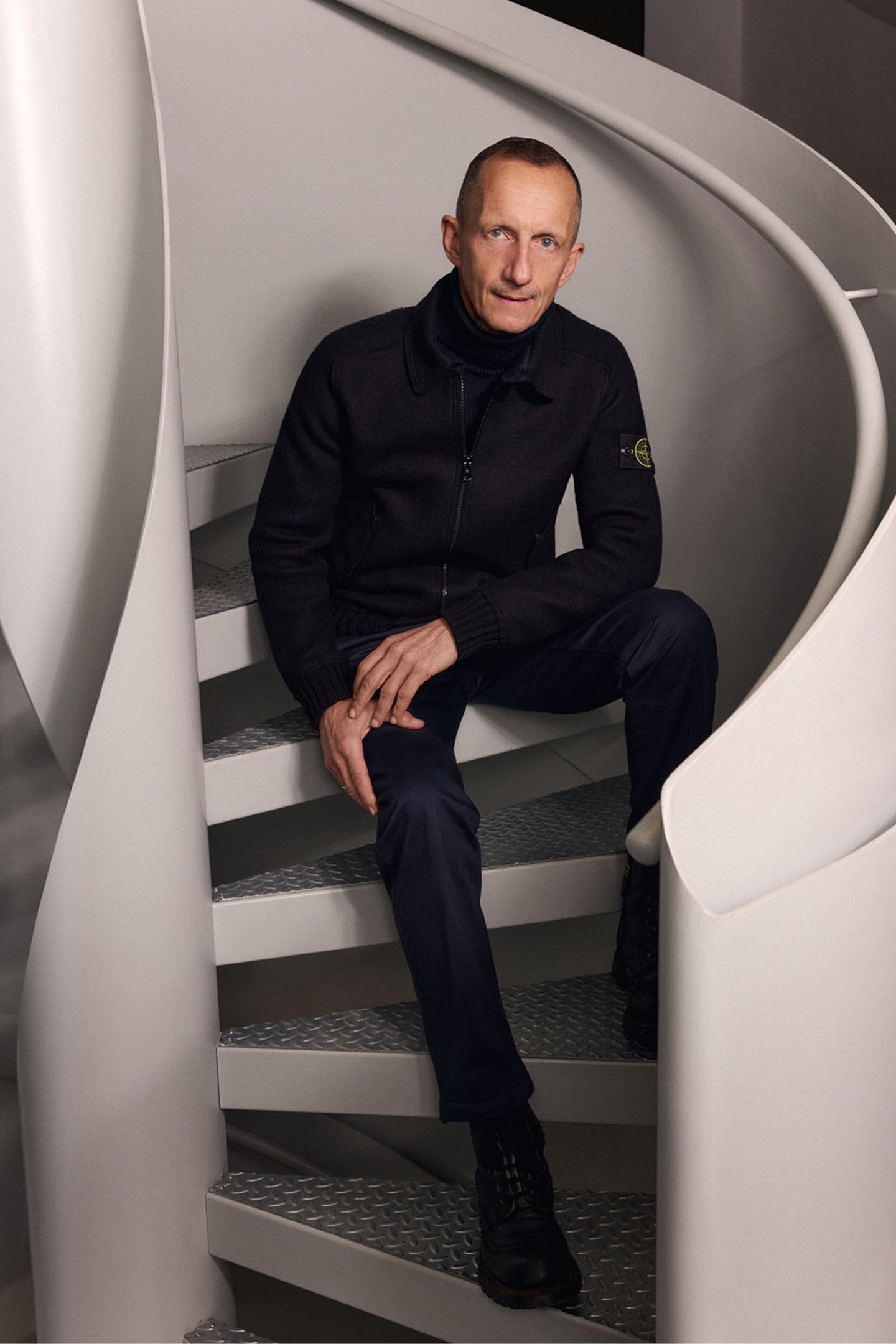

Stone Island has never actively recruited its community. Since the early 1980s when young Paninari in Milan adopted its compass-patch jackets, and through its long history with football terrace culture and UK grime, the Italian brand amassed one of fashion’s most committed followings without really trying.
That organic evolution has become one of the brand’s defining characteristics — and one of its greatest strategic assets.
So when former Gucci executive Robert Triefus joined as president and CEO of Stone Island in 2023 following Moncler’s acquisition three years earlier, his task was not to redefine the brand, but to articulate more clearly what had always set it apart.
This included writing the brand manifesto rooted in the concept of “Lab and Life” — Stone Island’s dual obsession with material innovation and cultural relevance — as well as identifying the five customer personas that underpin the brand.
To support that work, Triefus commissioned The Business of Fashion’s advisory team, BoF Insights, to track how the brand strategy was actually playing out across those five personas — and how they varied from market to market.
Over two years and four research phases, BoF Insights conducted consumer surveys across the US, UK, Japan and South Korea, while also drawing on AI-powered analysis of social conversations and customer behaviour across seven markets.
The findings told a clear story. From phase one to phase four of the research, the “Navigator” — typically an established professional drawn to Stone Island’s more elevated offer — grew from 7 percent to 34 percent of the online audience. Meanwhile, the female “Pioneer” engaged with the brand on an even deeper level, helped in part by South Korean DJ Peggy Gou becoming Stone Island’s first female community member. The brand’s evolution, the research showed, was reinforcing the authenticity that had always defined Stone Island — not diluting it.
Below, Triefus shares how the research shaped decision making across his leadership team, and why he believes the role of a brand leader is not to invent authenticity, but to protect and strengthen it.
Want to know how BoF Insights can help your brand? Contact us for a conversation.
BoF Insights: During your tenure at Stone Island, what have you learned about how you balance growing the brand while still maintaining its countercultural appeal?
Robert Triefus: That counterculture aspect of Stone Island is something that was established through the course of history. It wasn’t something intentional. This unusual aspect fascinated me — that at no time did the brand set out to reach those subcultures.
I think that is one of the most remarkable characteristics of Stone Island. Many luxury brands consciously try to manufacture cultural relevance. Stone Island never did. Its community emerged organically over four decades because people discovered the product, recognised something in it, and ultimately made it part of their own identity.
Here was a brand that had grown truly organically, truly through word of mouth, and that was something that I really wanted to protect.
Very early on I came to the conclusion that my responsibility was not to reinvent Stone Island, but to understand it deeply enough to articulate more clearly what had always made it exceptional. Leadership, in my view, is about stewardship. You have a responsibility to leave an authentic brand stronger than you found it, never different simply for the sake of change.
We have to be rigorous about not being perceived to sell out. Growth should feel like the natural consequence of authenticity, never a departure from it. The moment a community believes a brand is chasing relevance rather than earning it, you’ve lost something that is incredibly difficult to recover.
BoF Insights: How did you build on the authenticity that has defined the brand since the beginning?
As we sat down to think about what could be an authentic way of carrying that forward, we decided we needed to be ‘loudly implicit’ — turning the volume up, but in an authentic way, so that the community we had gathered over more than 40 years didn’t feel that we were somehow abandoning everything the brand stood for.
I’ve often described our communication philosophy as being ‘loudly implicit.’ We aren’t interested in shouting louder than everyone else. We’re interested in making our values more visible without ever becoming performative. That distinction has become an important guiding principle for us.
That is why we brought together 12 members of the community for ‘Community as a Form of Research.’ Importantly, we didn’t think of them as ambassadors in the traditional sense. They are individuals who already have an authentic relationship with Stone Island. The project isn’t about recruiting a community; it is about recognising one that already exists and giving it a voice. The first person who said ‘I’m in’ was Jason Statham. He’s a huge enthusiast of Stone Island and has built a remarkable wardrobe over many years.
What makes the project truly authentic is not only that all of those individuals are connected with the brand in some way, but also the Hans Ulrich Obrist questionnaire. Hans Ulrich’s questions reinforce exactly what we were trying to achieve. They don’t ask people to talk about Stone Island; they invite them to talk about themselves. Through those conversations, you begin to understand why individuals who come from completely different worlds are drawn to the same brand. For me, that is far more powerful than a traditional advertising campaign because it reveals the values that genuinely unite the community.
BoF Insights: Why did you feel it was important to track brand perception over time and what motivated you to work with BoF Insights specifically?
Robert Triefus: Within our three-year business plan we identified five customer personas. I’ve always believed that the most interesting thing about customers isn’t who they are, but why they make the choices they make. Psychographics are ultimately more enduring than demographics because motivations change much more slowly than age or income.
Intuition starts strategy; evidence refines it.
What I wanted during those first two years was a way of continuously testing whether everything we had inferred through our research and the development of the brand strategy was actually proving true in the marketplace. Strategy should never become dogma. The moment you stop questioning your assumptions, you stop learning.
That was what attracted me to BoF Insights. There was the combination of traditional qualitative and quantitative research, but also a very innovative capability that enabled us to observe how our hypotheses were playing out in real communities.
What interested me wasn’t AI for its own sake. It was the opportunity to understand behaviour rather than simply opinion. Surveys tell you what people say; broader behavioural analysis helps you understand what people actually do. The combination of the two gives you much greater confidence in your strategic decisions.
Through social conversations and wider community analysis we could examine whether the five personas we had developed were genuinely reflected in the people engaging with Stone Island across different markets.
What emerged over those two years became an extremely valuable discipline. Every quarter we had the opportunity to challenge ourselves — not only on the personas, but on the wider strategic direction of the brand.
One of the things I appreciated most was that the conversations quickly moved beyond research. They became strategic discussions about the evolution of the brand, drawing on BoF’s broader understanding of the luxury sector as well as our own ambitions for Stone Island.
It was equally important that BoF Insights had access to my first-line management team.
Strategy only becomes powerful when the people responsible for executing it also participate in validating it. I wanted the entire leadership team — not just the CEO — to feel ownership of continuously challenging our assumptions and refining our thinking.
BoF Insights: We saw the ‘Navigator’ persona grow in audience share quite significantly over the different phases of the research, reflecting your push towards a more subtle kind of luxury. Was that growth intentional or surprising?
Robert Triefus: The Navigator is often someone between 35 and 55, but for me the defining characteristic is not age — it’s mindset. They’ve reached a point in life where they’re buying less but buying better. They value craftsmanship over fashion, innovation over novelty and discretion over conspicuous consumption.
The Ghost collection probably speaks most directly to that individual. Its growth over recent years has reinforced our confidence that this persona genuinely exists and that our elevation strategy is resonating.
Part of our strategy was to double down on what Stone Island has always done exceptionally well — outerwear, knitwear and above all material innovation.
Everything begins with product. Marketing can amplify a great product, but it cannot compensate for an ordinary one. Community ultimately follows product, not the other way around.
At the same time, we wanted every part of the brand experience to evolve — from the collection to the retail environment.
The Navigator naturally appreciates investments such as the OMA retail concept because they reflect the same values as the product itself: research, innovation and quiet confidence.
Luxury today is increasingly about substance rather than display. I think the Navigator reflects that broader cultural shift.
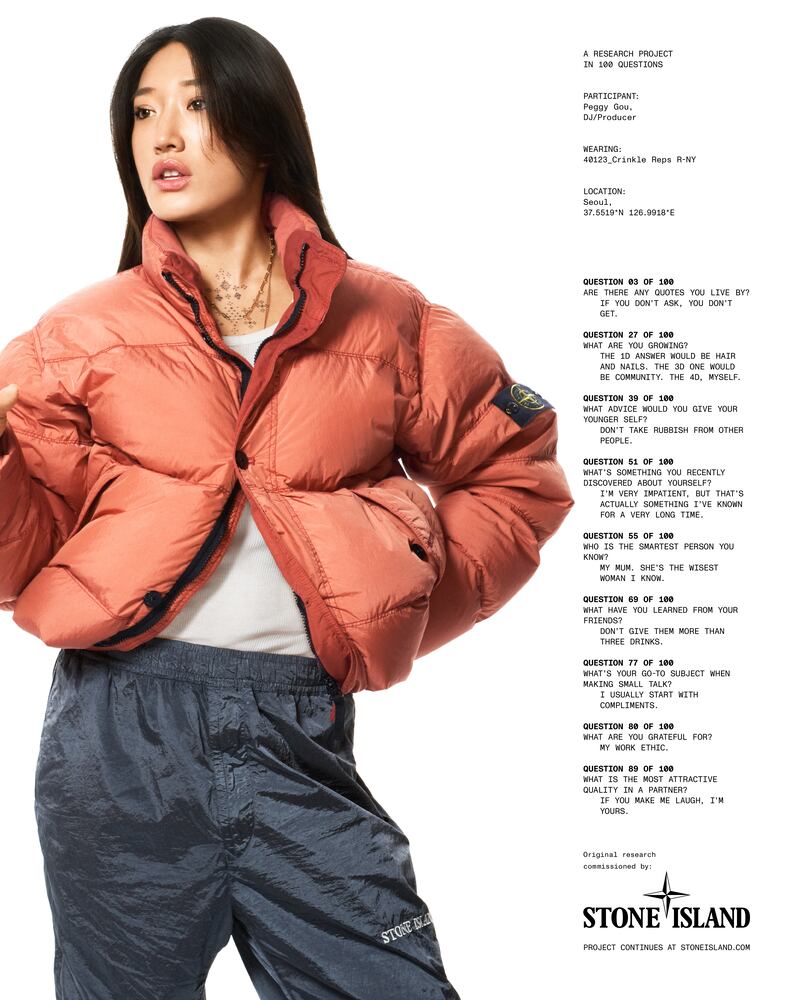
BoF Insights: Women account for around 20 percent of Stone Island’s sales, but there is no dedicated womenswear line. Our research also showed that introducing Peggy Gou as Stone Island’s first female community member triggered a rise in female customer engagement. How are you building on that?
Robert Triefus: An increasing proportion of our audience is made up of women buying Stone Island for themselves, and that observation led us to define what we called the ‘Pioneer’ persona.
The Pioneer is independent, curious and intentional. She appreciates Stone Island precisely because it isn’t designed around traditional ideas of menswear or womenswear.
We approached the decision to introduce a female member of ‘Community as a Form of Research’ with considerable humility. Not because we wanted to broaden our audience, but because we understood how protective the community is of the brand’s authenticity.
Peggy wasn’t chosen to attract female customers. She was chosen because she already embodied the qualities we associated with the Pioneer — curiosity, creativity, independence and a genuinely global outlook.
The positive response confirmed something important. Communities recognise authenticity remarkably quickly. When people genuinely belong, the community instinctively understands it.
Knowing that this audience is growing has naturally influenced how we think about sizing and colour. But we continue to believe that the product itself should remain fundamentally universal rather than segmented.
BoF Insights: You’ve now run four phases of this research with us. What has this process changed about how you make decisions as a team and what’s had the biggest impact on your strategy?
Robert Triefus: One of the things I wanted to establish during those first years was a rhythm of continuous reflection. The purpose of those checkpoints wasn’t to rewrite the strategy every quarter. It was to understand where we needed greater conviction and where we needed greater humility.
The research also reminded us that global brands are never experienced uniformly. One of the biggest mistakes global brands make is assuming they have one global reputation. They don’t. They have multiple local reputations, each at different stages of maturity. That has become incredibly important for Stone Island. Brand awareness, cultural references and customer expectations evolve differently in Seoul, Tokyo, London or Los Angeles.
The challenge is therefore not to create different versions of the brand. It is to remain globally consistent while acting with much greater local intelligence.
Those insights have allowed us to calibrate our priorities according to the maturity of each market while remaining completely faithful to one global identity.
Ultimately, what this process gave us wasn’t permission to change Stone Island. It gave us confidence that remaining true to its DNA was also the strongest long-term business strategy.
This interview has been edited and condensed.
BoF Insights conducted four phases of brand perception research with Stone Island between 2023 and 2025, combining consumer surveys across the US, UK, Japan and South Korea with AI-powered analysis of social conversations and customer behaviour across seven markets.
Want to know how we can help your brand? Contact us for a conversation.
 Opens in new window
Loading recommended reads…
The Denim Tears founder’s new collaboration with Adidas is one of the most overtly political sneakers of the last few years. Could it be a sign of what’s to come?
The company’s share price notched its biggest weekly rise since 2020 as investors bet on softer gold prices to bring customers back to stores.
Workers staged fresh demonstrations in Dhaka Thursday, forcing factories to suspend operations despite government promises to raise wages before the end of the year.
The cult menswear designer and former Demna collaborator is returning to Balenciaga as owner Kering seeks to revive sales at the French house.