Agenda-setting intelligence, analysis and advice for the global fashion community.
Agenda-setting intelligence, analysis and advice for the global fashion community.

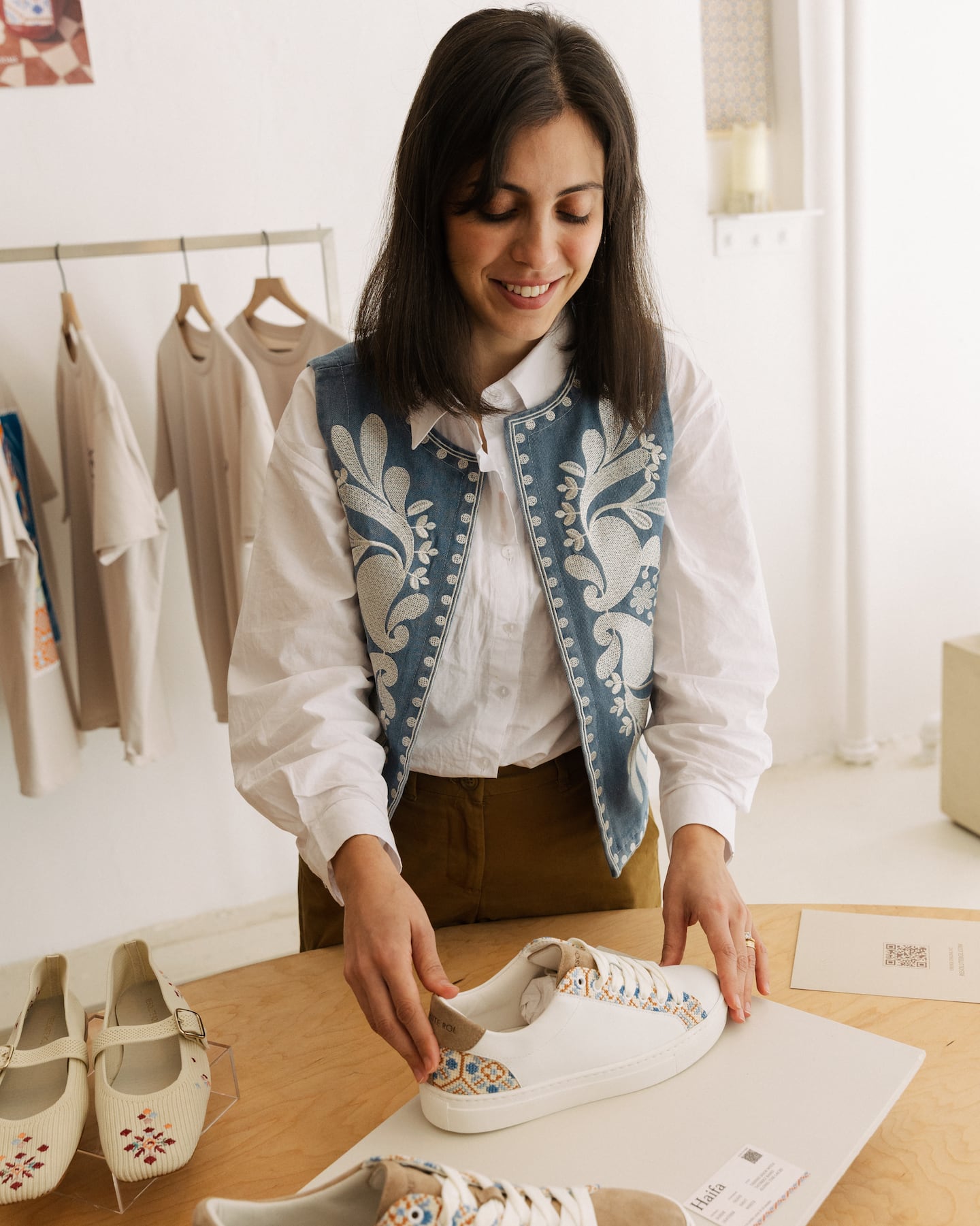
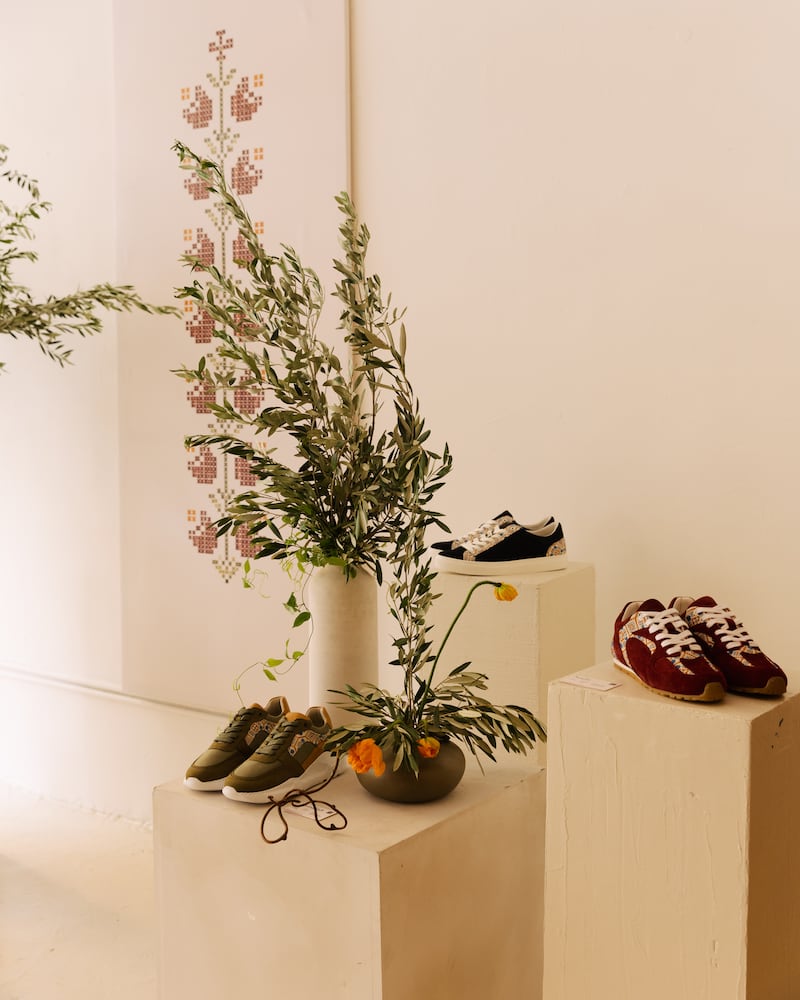
NEW YORK — In an open space decorated with white clay vases holding olive branches and eight-feet wall prints with traditional tatreez patterns, Palestinian footwear label Resolute RGL opened its first physical pop-up in New York’s Lower East Side.
The one-day opening, which garnered attendees in the hundreds, was accompanied by a cultural evening with live music and the release of a limited-edition T-shirt line in collaboration with American graphic artist Shepard Fairey.
For Resolute RGL, short for “Reclaiming Global Looms,” the moment marked a new phase of business — showcasing its products in a physical retail environment for the first time after having built its audience entirely online through drops and on-demand.
The brand officially launched last March, when co-founder and Palestinian filmmaker Basel Adra wore the sneakers to accept an Academy Award for “No Other Land,” a documentary he co-directed about life in his hometown of Masafer Yatta in the West Bank, generating an immediate surge of international interest.
ADVERTISEMENT
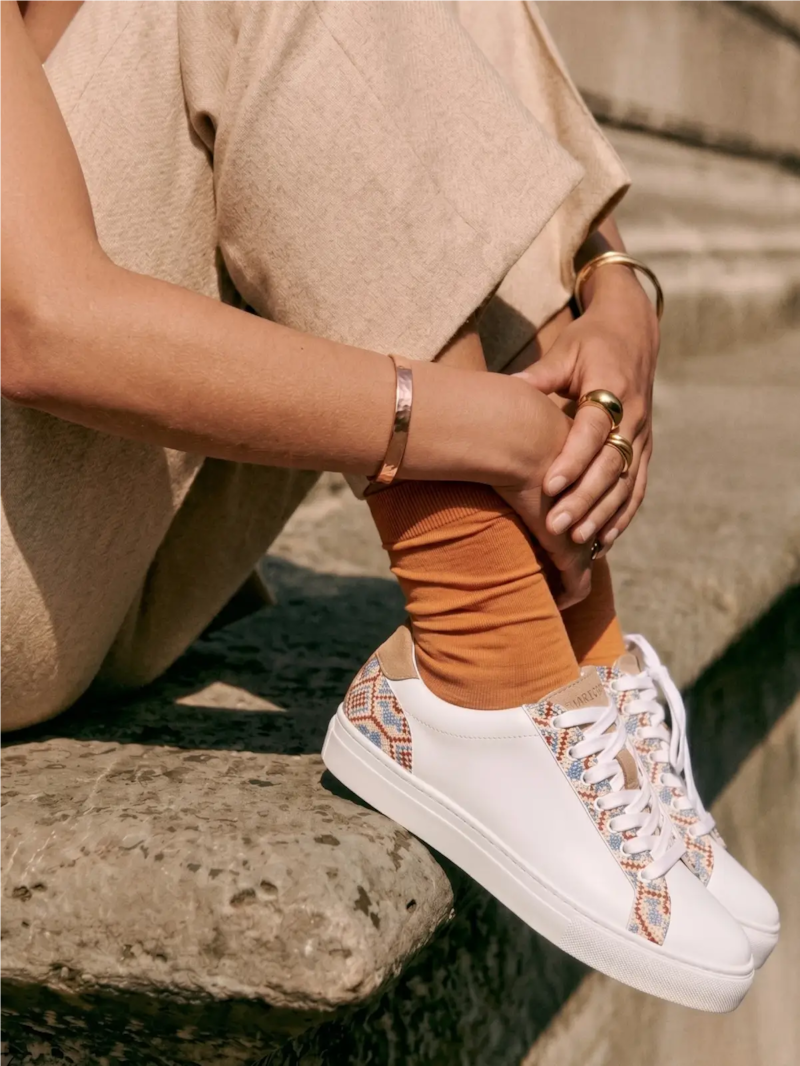
By the end of last year, the brand had generated $1 million in revenue, selling more than 6,000 pairs of sneakers embellished with its signature tatreez — a more than 3,000-year-old traditional Palestinian decorative embroidery that takes about one week to produce.
The idea had been years in the making.
Adra’s mother, Kifah Adra, ran a women’s weaving collective producing tatreez in the West Bank for over two decades. The group historically sold dresses, bags, scarves and other embroidered goods, largely to visitors to the region. Then in 2018, when Adra and Resolute’s co-founder, activist Joseph Levin, met, they saw the opportunity to connect that existing craftsmanship to a much larger international consumer base. A few years later, they were joined by husband-wife creative duo Nicholas Jacob and Maria Chacour. Together they established Resolute RGL.
The brand initially experimented with formal shoes before switching to a more accessible product: sneakers that still showcase Palestinian craft.
“We wanted something that would carry meaning,” said co-founder Jacob. But it also needed to be something consumers “want to wear, not only because of what it represents, but because they like it visually.”
From the outset the goal was to build footwear that people buy because it is desirable and comfortable, while creating economic value for the community producing it.
That premise has now attracted outside investment. After getting off the ground through self-funding and a $250,000 Kickstarter campaign, Resolute raised $1.27 million in investment this spring. The funds, which came from private investors and multiple social impact-driven venture capital firms in the UK, US and South Africa, have helped the brand grow its inventory, develop marketing and increase production capacity, according to Levin.
“We didn’t want to create a charity,” Jacob said. “We wanted to create a business that could sustain itself and create profit.”
ADVERTISEMENT
Resolute’s sneakers are produced through an unusual supply chain that stretches from Masafer Yatta in the occupied West Bank to factories in Portugal. Designed around the movement restrictions and safety concerns that shape daily life in the region, raw materials and threads are delivered directly to women artisans in Kifah Adra’s weaving cooperative, who embroider panels of tatreez in their homes. The finished panels are then collected by a representative, cleared past Israeli checkpoints and finally sent to Europe, where they are incorporated into hand-assembled sneakers and shipped to customers worldwide.
Those are logistical hurdles that would be daunting for any company, let alone a small startup. Resolute spent its first year cautiously testing its market, offering two initial models in a handful of colours. Feedback from customers surprised even the founders. Many bought the sneakers because of what they represented, but returned praising their comfort and quality, Levin said.
“We did not set out to make a mission-driven brand,” he added. “We set out to make the most amazing shoe you could actually wear and love.”
At the same time, Resolute needed to prove that demand could translate into meaningful economic activity in Masafer Yatta. Its shoes retail for between $180 to $360, a premium positioning meant to reflect the time, effort and craft that goes into hand-making each individual product.
Besides receiving a wage above the local norm for their embroidery, the women’s weaving cooperative has a share in the business. Together with Adra and his mother (who founded the collective), they are the company’s largest shareholders with more than half of the business’ equity, according to Levin. The rest is split between the other co-founders and external investors.
The company’s success has already had a tangible impact on the local community. The collective has grown from 43 women to around 250 since April this year, creating a source of income in a region where access to traditional agricultural livelihoods, primarily olive farming, has become precarious.
Those pressures have intensified as settler attacks, demolitions by Israeli forces and related access restrictions across the West Bank have increasingly damaged or seized agricultural land and homes. The wider Hebron region, where Masafer Yatta is located, is among the communities particularly affected and displaced, according to the United Nations Office for the Coordination of Humanitarian Affairs.
The challenge now is proving Resolute can sustain demand beyond the cultural moment that propelled its launch.
ADVERTISEMENT
Until recently, much of the brand’s growth has come through word of mouth, social media and the visibility generated by celebrity supporters, including Natalie Portman, Mark Ruffalo and Cynthia Nixon. Increased consumer sympathy for the Palestinian cause driven by the war in Gaza has also boosted engagement. Now, the company is trying to build awareness more intentionally — and convince customers who may not know Resolute’s story to buy the product on its own merits.
The brand opened Stockholm Fashion Week earlier this summer and held a presentation during Paris Fashion Week in the spring, putting its products in front of an international fashion audience. Its New York pop-up takes that strategy a step further by giving customers a dedicated space to see and try on the shoes.
New York was a natural place to start. The city is home to Resolute’s largest customer base and the US is its biggest market, according to Levin. But the company is already looking beyond the city for its next activation, with another pop-up planned for Paris in December.
With the new funding it raised earlier this year, Resolute has hired a marketing team, revamped its website and invested more in its production and delivery operations.
Those investments are paying off. Delivery times have fallen from around 10 weeks to four, helped by more space to store inventory, being able to secure larger stocks of raw materials at once and growing production capacity as more embroiderers joined the collective. A new global distribution centre expected to open by early November is intended to shorten fulfilment times further. The brand now aims to reach profitability by the second quarter of next year, said Levin.
“We want to grow five times in the coming year,” said Levin. “We now have the set-up to make 30,000 shoes versus what we could just a year ago, and want to hit that by mid-next year.”
Meanwhile, back in the West Bank, where Kifah Adra’s passion for traditional craft laid the foundations for the brand, the significance of the project remains much closer to home.
Over the past year, she has watched younger women learn tatreez after seeing their mothers and grandmothers earn money from the craft, while older women have picked up new skills to meet Resolute’s production needs. The cooperative’s equity in the brand means its success could also bring more value to the local community as it reaches a position where it can redistribute profits.
She now hopes that its growth will allow even more women, including those beyond Masafer Yatta, to participate.
Her dream is that one day the collective will have a store of their own in the village — a place where, instead of adding shoes to a cart to reach customers around the world, international visitors can come buy them where they were originally made and “listen to the women and to the story of the tatreez,” Adra said.
Loading recommended reads…
The designer leaned into the glamour and sex appeal of the storied Parisian fashion house. Sales nearly tripled during his tenure before sliding in recent years.
BoF’s editors pick the best shows from the Spring/Summer 2027 fashion season.
Brands may be racing to invest in new technology, but the biggest barrier to online sales is far more basic, finds BoF Insights and Amazon Fashion & Sports’ latest report ‘Inside Fashion & Sports E-Commerce.’
Every photographer is telling their own tale, says Walker, but his new exhibition also offers an emotional document of the triumphs and challenges of queer culture.