Agenda-setting intelligence, analysis and advice for the global fashion community.
Agenda-setting intelligence, analysis and advice for the global fashion community.

SHANGHAI — A queue regularly snakes out the door at leather-goods label Songmont’s flagship store on Shanghai’s bustling Huaihai Zhong Lu. Its ranks are often swollen by international tourists, who make up around 60 percent of the store’s customers. Sometimes visitors arrive as part of guided tours, directed by an organiser who lends support navigating the line. Interest in the brand is such that LVMH chair Bernard Arnault dropped by one of its stores when he visited Shanghai last year, reportedly buying two bags.
Songmont’s popularity reflects wider shifts playing out across the Chinese market. A once ravenous appetite for Western luxury goods has cooled alongside the country’s economy, replaced by more considered spending: shoppers are seeking out new options that offer high quality, strong creative identity and competitive price points, and an emerging cohort of domestic brands is stepping into this gap with ambitions to extend their reach globally.
Shanghai is at the heart of this shift.
As a platform for Chinese design talent and the first entry point for Western brands targeting the domestic market, the city has long been China’s fashion capital. But in recent years it’s become a springboard for a far wider range of labels, both local and international, as they tap the city’s shopping districts and trade platforms to drive growth in China and abroad.
ADVERTISEMENT
“Shanghai is now more than a gateway to China,” said Galeries Lafayette China chief executive Nicolas Morineaux. “The decade of Chinese brands is now open.”
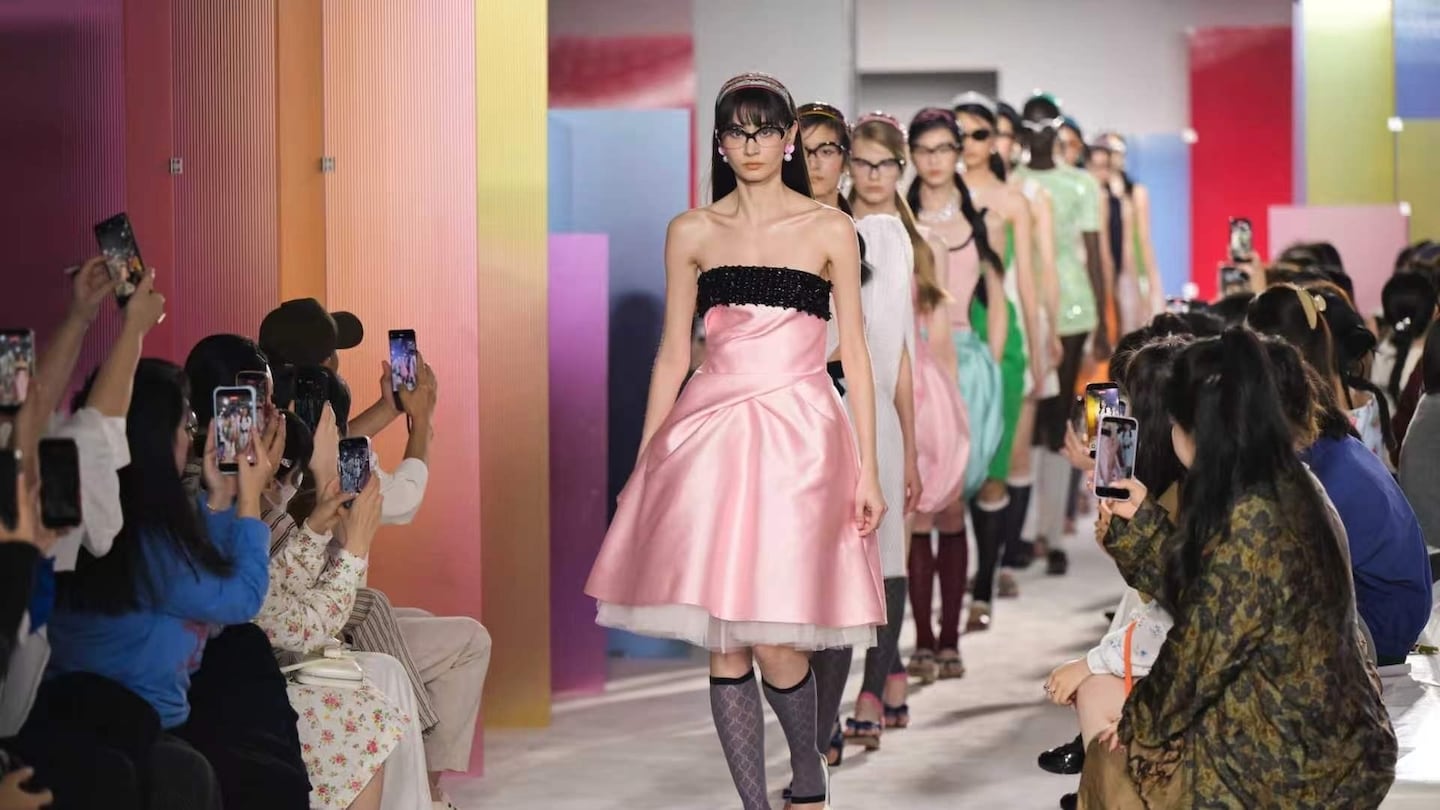
At Shanghai Fashion Week last month the city buzzed with a vibrant energy. Fans and influencers flocked to shows decked out in their favourite brands from Miu Miu-coded Shushu/Tong to Oude Waag’s mix of sharp tailoring and soft draping.
But a lot of the action took place at the official trade shows that serve as a commercial linchpin for the week. The event’s ambition has long been to build an “influential high fashion trade platform in Asia,” said Lv Xiaolei, the executive vice chairman of Shanghai Fashion Designers Association and secretary general of Shanghai Fashion Week’s organising body.
More than 800 brands displayed their products across an established network of showrooms, Shanghai Fashion Week said. At Mode, a towering space spread over multiple floors, attendance was up more than 15 percent compared with last season, according to the organiser. Over half of the exhibitors were international labels looking for exposure to China’s huge fashion market. Meanwhile, international buyers in attendance this season included representatives from Galeries Lafayette in Paris, Harrods in London, Antonioli in Milan, 3NY in New York, as well as stockists from across Asia, the Middle East and Africa, it added.
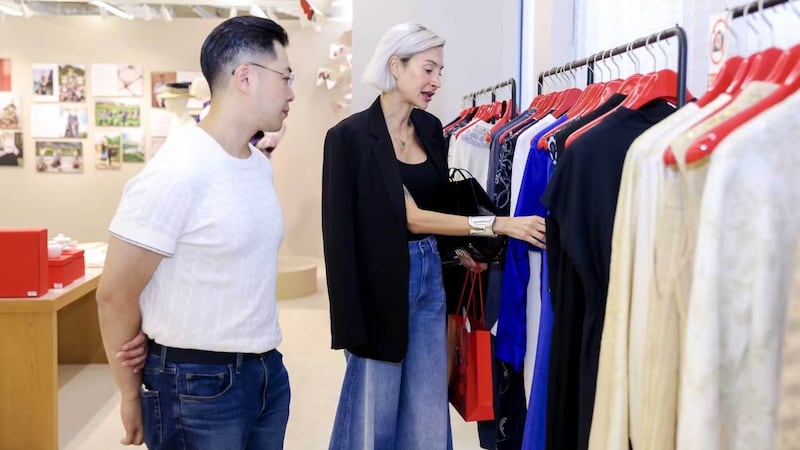
Exhibitors included Saudi Arabian founder Arwa Alsaleh, who made Shanghai her first stop as she explores expanding her demi-fine jewellery brand L’rosha internationally. Knitwear designer Zlata Belokobylskaia said she is also looking at China to grow her label Zlatasiberia as European markets have become less accessible to Russia-based brands.
Fashion showroom and buying agency DFO, which hosted L’rosha among its brands this season, has seen an upsurge in interest from South-East Asian designers looking to engage with the Chinese market over the last 18 months, CEO Meimei Ding said. Some have even asked about staging shows during Shanghai Fashion Week before establishing a commercial presence in the country, viewing it as a way to burnish their credibility with consumers in their home countries, she added. Buyers weren’t just browsing — they were placing orders as well, Ding said.
To be sure, there are still reasons to be cautious. A years-long real-estate downturn and new taxes on international wealth are weighing on spending and Shanghai’s consumer market is rapidly shifting. Sales at major Western luxury brands, which benefitted from a period of highly conspicuous consumption in the run up to and during the pandemic, are now suffering as shoppers become more discerning and more price conscious.
“It’s not true that Chinese consumers aren’t shopping; they’re just not shopping how they used to,” said Ding. “When I first opened the showroom… you just needed to put a piece of clothing out there and it would sell... Now there’s a much clearer point of view, a much more sophisticated buyer.”
ADVERTISEMENT
Walk the area around Shanghai’s commercial thoroughfare, Nanjing Xi Lu, and you will get a sense of the city’s dynamic and changing retail market.
Begin at Pane, a footwear brand that, like Songmont, attracts queues of shoppers and international travellers. Nearby is Super Zhuanzhuan, a massive 6,000-square-metre flagship the secondhand chain opened last month and a sign of the country’s booming resale market.
Keep strolling and you’ll encounter a varied and dynamic shopping ecosystem — a microcosm of the shifting retail landscape in Shanghai and a lens into the wider Chinese market. High-end malls in the area are scrambling to switch up their assortment to offer more contemporary and accessibly priced labels as demand for some top-tier luxury brands ebbs. New retail spaces serve a rotating set piece of experiential and immersive pop-ups that attract plenty of footfall and social media content, but unclear returns. The most vibrant areas have found ways to blend trendy and experiential fashion, food, leisure, wellness and lifestyle retail together.
“It’s an everything, everywhere, all at once strategy,” said Morineaux. The result is a more convenient and fun shopping experience that drives footfall and promotes a sense of curiosity, almost like shopping on a platform like Tmall or Taobao.
“It’s one of the largest and most impactful trends on the Chinese market,” Morineaux added. “To some extent it’s an attempt to recreate a browsing approach in a [physical] retail environment.”
New, high-concept multi-brand and mono-brand stores are also mushrooming across the city, reflecting a shift away from malls to more of a “city walk” culture — a social media-fuelled movement that’s powering urban exploration. Store openings in October included Swedish brand Our Legacy and Shanghai-London design studio Samuel Guì Yang. Contemporary womenswear label Ruohan is set to open its first shop this month.
If the rest of the world is looking at Shanghai as a gateway to China, the city’s dominant brands and emerging designers are looking at the city as a gateway to the rest of the world.
Shanghai is positioning itself as a two-way gateway — a launchpad for global brands entering Asia, and a springboard for Chinese designers scaling abroad.
— Irene Yu
China’s move to open up tourism by offering visa-free travel to citizens of dozens of countries in recent years has helped boost interest in domestic labels. “China Haul” videos that show travellers returning from the country with suitcases full of new products have gone viral. Alongside Songmont, brands like Pane and “Chinese Zara” Urban Revivo have proved popular.
ADVERTISEMENT
Shanghai’s emerging designers are also becoming more assured and consistent, international buyers at Shanghai Fashion Week said. The city lures the country’s top creative talent, many of whom study at fashion’s leading institutions globally before returning to China, where they can plug into a thriving commercial ecosystem and an exceptional and comparatively affordable manufacturing base.
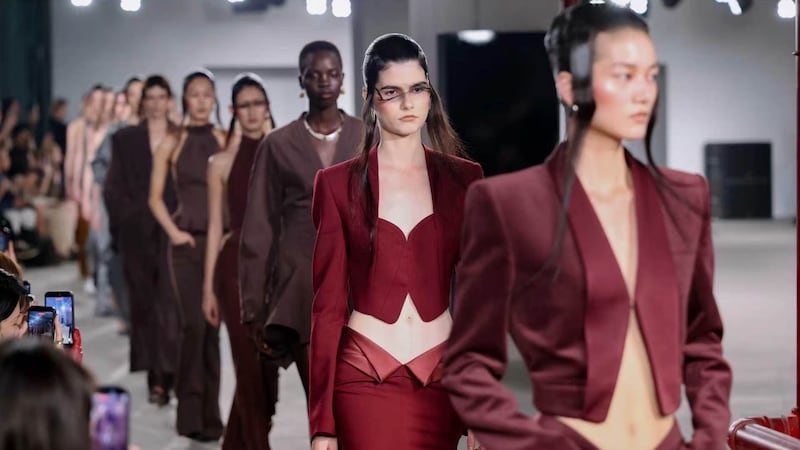
“There’s a very important transition from individual creative names to mature fashion businesses with quite strong branding, a retail presence, commercial potential and also quite strong social influence,” said fashion media veteran and brand strategist Dan Cui.
Though some critics still complain that designs on show can be derivative, more brands are finding ways to blend Chinese cultural references with contemporary design codes in exciting ways that can resonate globally, buyers said.
“Shanghai is positioning itself as a two-way gateway — a launchpad for global brands entering Asia, and a springboard for Chinese designers scaling abroad,” said Irene Yu, general manager at Hong Kong-based retailer Joyce. “That dual role is new.”
Disclosure: Sarah Kent attended Shanghai Fashion Week as a guest of the organisers.
From Brooklyn to Shanghai, a multibrand retail renaissance is taking shape, powered by a thirst for independent stores with a more hand-crafted, human quotient in a world flattened by digital transactions.
A subtle and contemporary Chinese-inflected aesthetic has long made the label the star of Shanghai Fashion Week. After over a decade in business, it is finally ready for growth.
On his first visit to Shanghai since before the pandemic, Imran Amed finds a market that has fundamentally changed — from status spending to stealth wealth, from megabrands to homegrown labels, from fashion focus to lifestyle emphasis — and asks, can Western brands catch up?

Sarah Kent is Global Markets Editor at The Business of Fashion. She is based in London and also oversees BoF's sustainability coverage.
Loading recommended reads…
In this week’s High Margin, a search for images that cut through our visual fatigue — with leads from M/M Paris, Ferdinando Verderi and stylist Emilie Kareh. Plus: Tod’s designer exit; Burberry’s resilient sales.
The producer price index rose 6.5% from October 2025, an acceleration from the prior month, according to Bureau of Labor Statistics data out Friday. On a monthly basis, the PPI increased 0.3%.
The creative director and strategist joins Imran Amed on The BoF Podcast to discuss the evolution of his career, the realities of shaping artist narratives and why long-term collaboration outperforms short-term marketing.
The former Nvidia CEO was central to an AI boom that has propelled the US stock market and fueled the country’s unmatched luxury spending. After his exit, nobody is sure what happens next.