Agenda-setting intelligence, analysis and advice for the global fashion community.
Agenda-setting intelligence, analysis and advice for the global fashion community.
Despite the modern fixation, beauty “dupes” are not a contemporary concern. An article in a 1937 edition of the trade journal The Drug and Cosmetic Industry describes cosmetic chemists’ “thankless, yet important” job of matching the bestselling formulas of the day. “In such work,” the article reads, “The cosmetic chemist finds himself dealing not only with emulsion problems, but with emotional ones as well.”
Emulsive and emotional problems have only persisted in the intervening decades. Demand for beauty dupes, which have become a fully fledged, almost expected category of the beauty market, shows no signs of slowing. But as dupe brands such as Mco Beauty and Makeup Revolution grow more brazen with their imitations, the lines between duping, counterfeiting and simply participating in a craze have become increasingly blurred: A single brand may create a trend, but it’s hard to confine the aesthetic solely to that label.
“It becomes really difficult to draw a line and say: ‘This amount of copying is acceptable, this amount of copying isn’t,’” said Sarah Rosenberg, an associate at law firm Arnold and Porter, who specialises in intellectual property and brand protection.
Price is often cited as the key motivator for switching to a dupe label, but in the current fractious political landscape, brands can fall out of favour for other reasons. Joie (who declined to give her surname), a moderator of r/Sephora, one of Reddit’s largest beauty communities, said her team tries to limit political chatter, but that it’s inevitable. “Controversy across brands triggers dupe conversations,” she said. “That’s when the price doesn’t even matter: People want to find a new brand to support.”
ADVERTISEMENT
A hit to the perception of quality of premium brands has also levelled the field. In a survey by marketing platform Standard Insights, “price-to-quality mismatch” was cited as the main frustration for 55 percent of respondents. Customers, less moved by a luxury label’s credentials, are more susceptible to the bolder plays of duping brands.
Some premium brands are fighting back. Cosmetics maker and makeup artist Charlotte Tilbury’s “Legendary for a Reason” campaign, unveiled in January 2025, is meant to reaffirm the label’s authority, but Tilbury’s repeated battlecry — “When you dupe, you dupe the customer” — hasn’t landed with all shoppers. Some customers simply see forking out for a luxury product as a rip-off.
While there are legal routes for labels that feel their imitating competitors have crossed a line — borrowing elements from formula to packaging and even names — truly recouping their defecting customers will require more of a back-to-basics approach.
With brand perception no longer a moat, premium labels must work on both elevating their offerings, and communicating their benefits more effectively.
Dupes in the beauty industry are their own peculiar category, said Rosenberg. Whilst fashion dupes are purely imitations of form, and tend to be branded “knock-offs,” beauty dupes begin by replicating function. “We don’t apply [beauty] products or carry them around in public. It’s more about the consumer experience,” she said.
Formulas are the crux of a dupe. While a good cosmetic chemist has always been able to come up with a fairly close approximation of a product, said Kelly Dobos, a consultant cosmetic chemist and professor at the University of Cincinnati, the introduction of AI-powered software is only making the process easier.
Ingredients suppliers and contract manufacturers are also naturally incentivised to feed the dupe machine, said Dobos. An ingredient supplier who discovers something buzzy (such as the popular K-beauty ingredient PDRN) will want to sell as much of that stock as possible, while for contract manufacturers, it’s a far more convenient and cost-effective process to have a library of formulas available to prospective brands, rather than creating a custom formula each time.
Formula dupes are seen as largely unproblematic. This is thanks in part to the rise of “ transparency” marketing from the likes of The Ordinary, Beauty Pie and The Inkey List, in which the juice in the bottle is emphasised in lieu of celebrity ambassadors or fanciful claims.
ADVERTISEMENT
It’s also difficult to draw the line between when a product is being duped, or has simply sparked a trend. Take Rhode’s Glazing Milk or Peptide Lip Treatment, both of which ignited a fervour for their ingredients and formats. Those that followed with their own similar offerings could not be called duped as much as they would be seen as playing catch-up.
Formulas are often not the biggest issue for perennially duped brands, whose packaging, brand identity and online presence are also often imitated. “That’s why there’s a fine line between what is a dupe and what is a counterfeit,” said Dobos.
Search optimisation targeting is an obstacle for many brands, particularly on Amazon, where brands can bid on key terms used by customers in their search queries. It’s a particular challenge for cosmetic tools maker Beautyblender, said company president Alexis Tedesco, as users searching for the product are met with pages of similarly hued, multipack dupe sponges for a fraction of her hot pink, teardrop-shaped original’s price. In October, it will launch its “There’s only one” campaign, highlighting its medical-grade foam and industry-first hydrophilic properties.
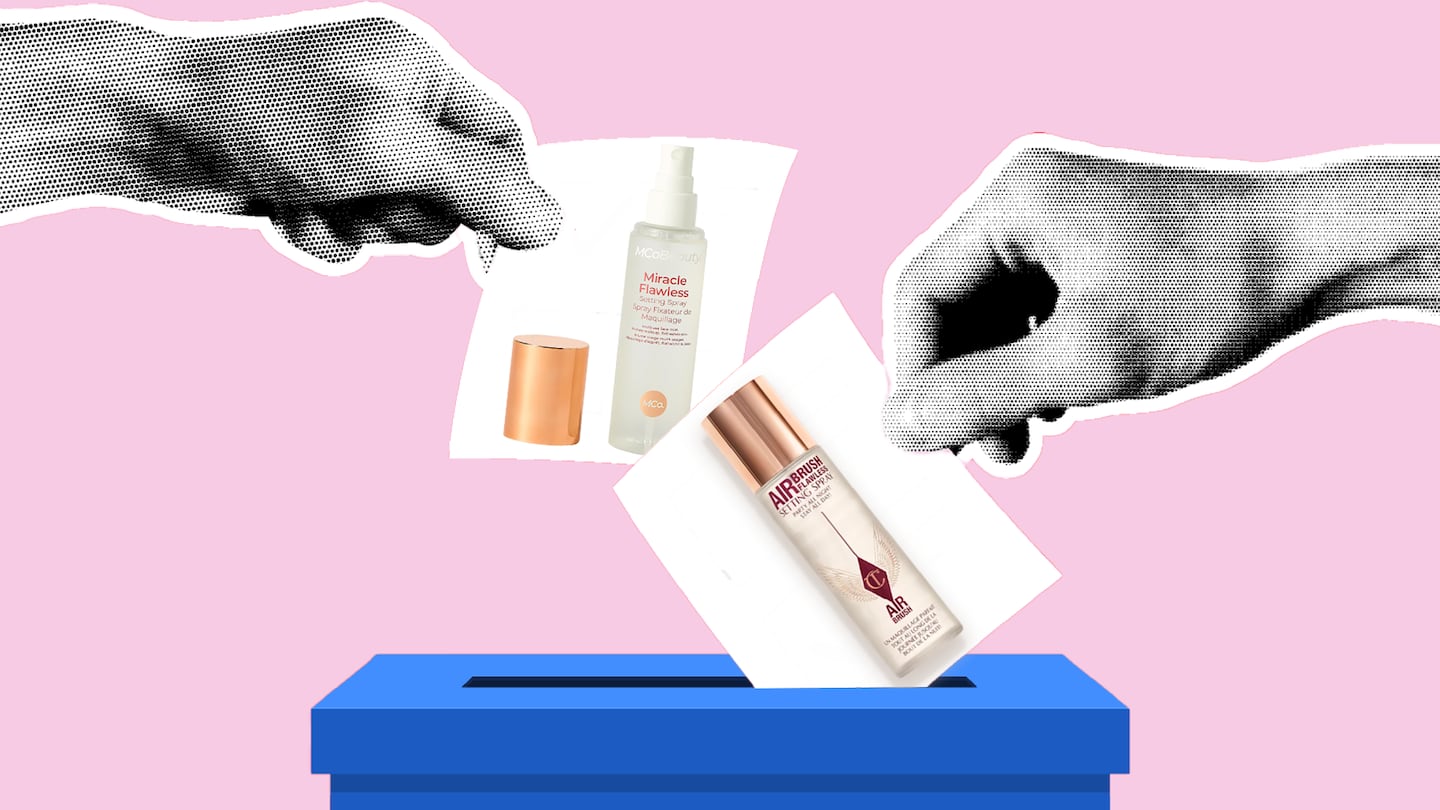
Where does that leave brands like Mco Beauty, for which resemblance is often the whole game? Its bestsellers, for example, include the Miracle Flawless Setting Spray (a dupe of Charlotte Tilbury’s Airbrush Flawless Setting Spray) and the Multivitamin Moisturising Primer (a dupe of Bobbi Brown’s Vitamin Enriched Face Base). Though lawsuits have been levied against Mco Beauty, many customers clearly feel no compunction in shopping from the Australian brand, which was valued at $1 billion at the time of its February 2025 acquisition by DBG Group.

Part of it is perhaps due to the tongue-in-cheek, self-aware marketing surrounding the brand’s audacious duping. In November 2025, the brand staged a pop-up in New York “duping” a Sephora experience, down to the brand’s iconic striped bags. Earlier this year, the brand released its first “superdupe”, a reissue of Urban Decay’s original All Nighter setting spray, shamelessly named: All Dayer.
Inviting customers, who already feel alienated by the price points of luxury labels, in on the joke is a powering marketing lever. “I work at a college, and it’s gone from a need to have designer products, to now people think you’re stupid if you do,” said Joie. “Why spend $60 on Chanel eyeshadow when you can get the dupe from ColourPop for $7?”
For a brand to truly protect itself from duping, it must become undupeable.
The whole point of the intellectual property system is to encourage creators to keep creating, said Rosenberg, adding that dupes can even incentivise greater inventiveness for premium brands.
ADVERTISEMENT
Customers are no longer satisfied by simply taking a brand’s word for it in terms of quality and value for money. Per Standard Insights, word of mouth was the largest influence on respondents who were weighing up whether or not to trade down.
Beyond community building to cultivate loyalty, brands are tasked with a simple, but challenging objective: Innovate first, and be the best.
Mcobeauty’s newest launch, crafted with precisely the same formula as its pricier forebear, Urban Decay, showcases an evolving strategy for ‘dupe’ brands.
The makeup artist and mogul is taking aim at rampant “dupes” of her best-selling products with a new campaign: “Legendary. For A Reason.”
This week, Priya Rao dives into the rampant copycats in beauty — and no, she’s not talking about dupes.

Rachael Griffiths is a Senior Editorial Associate at The Business of Beauty. She is based between St Helens and London, and covers beauty, wellness and industry news.
Loading recommended reads…
Fenty Beauty’s first 12-hour online shopping event, featuring Rihanna, shows how a new generation of brands are embracing the practised art of live selling.
The policy bars ads from ByteDance, which remains in charge of key parts of TikTok, and extends to third-party advertisers running campaigns that link to TikTok.
The departure of Athleta’s CEO for Lululemon is a chance to ‘reimagine the brand’s path forward,’ Gap Inc. CEO Richard Dickson wrote in an internal memo viewed by Bloomberg.
Opening in Q4 2026 on Saadiyat Island — at the heart of Abu Dhabi’s cultural district — Saadiyat Grove brings together luxury retail, hospitality, residential living and culture in one of the emirate’s most ambitious new developments. BoF speaks to Jonathan Emery, chief executive officer of Aldar Development, about the strategic vision behind the project.