Agenda-setting intelligence, analysis and advice for the global fashion community.
Agenda-setting intelligence, analysis and advice for the global fashion community.
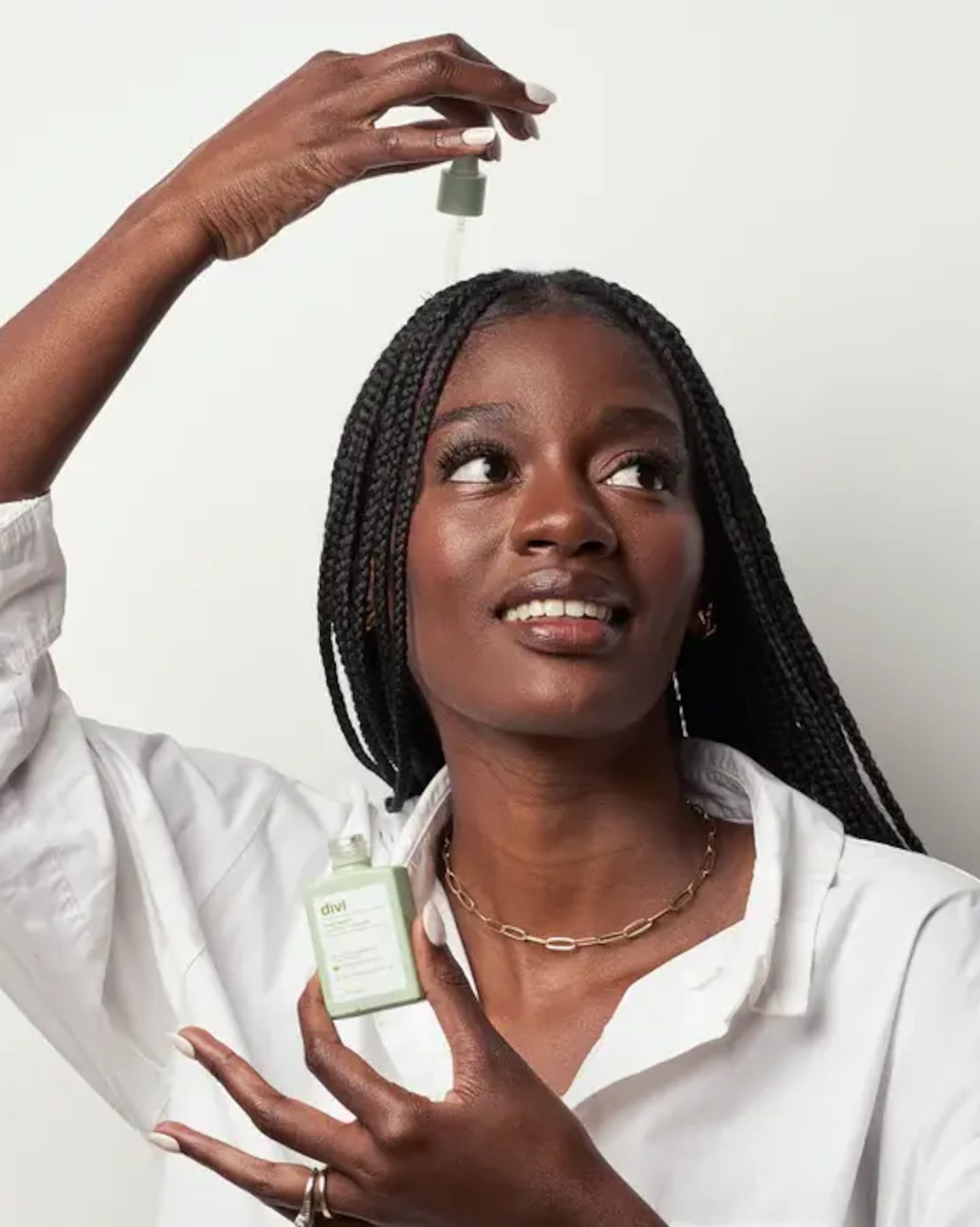
In late 2025, the digital team at hair-care brand Divi started noticing a rising new source of site traffic. Not only was it driving more users to the site each month, but it was converting to sales at a rate second only to those who clicked links shared by influencer and founder Dani Austin. The source: ChatGPT.
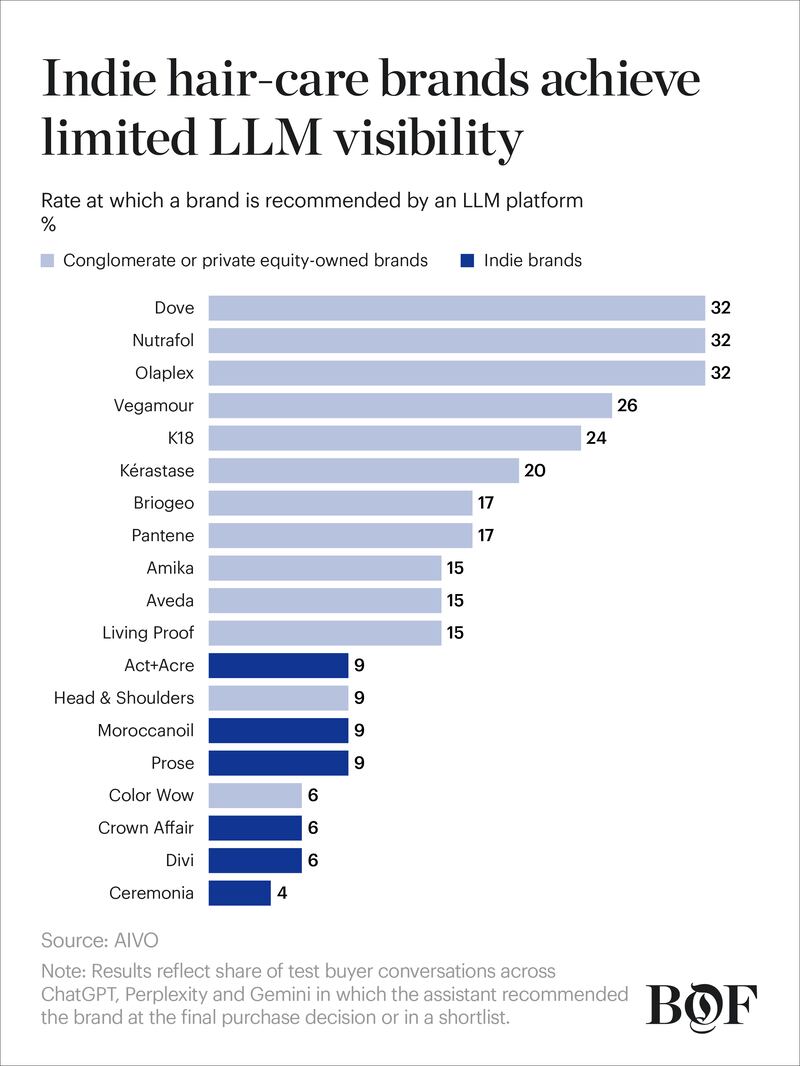
Divi is one of the few independent hair-care brands recommended to users turning to the platform for beauty advice, according to a ranking by AI search intelligence firm Aivo dominated by conglomerate-owned giants like Dove and Olaplex.
Unlike social media influencers, who are eager to mention unknown new labels, large language model (LLM) platforms tend to favour more established companies. With more resources to spend on generative engine optimisation (GEO) techniques and the online visibility that helps their brands’ names surface, public conglomerates like L’Oréal Group, Estée Lauder and Unilever lead in the rankings for chatbots’ recommendations. But indie beauty has not given up on the AI race.
“It’s hard to compete with those bigger brands because they have budgets in the seven, eight figures per month,” said Nitesh Nihalani, vice president of digital at Divi. “How smaller brands can win is doing a lot of the ‘boring work.’” The company had made a concerted effort to improve its visibility on LLM platforms, with a strategy that includes technical capabilities, content and public relations.
ADVERTISEMENT
When asked product recommendation questions, LLMs like OpenAI’s ChatGPT, Anthropic’s Claude and Google’s Gemini inform their answers in part by scanning published information, like magazine articles or scientific journals, for their insights. As a result, brands with long histories of media spend are already way ahead. Six out of 19 of the most-recommended hair labels by LLMs are independent. For skin, the proportion is even lower.
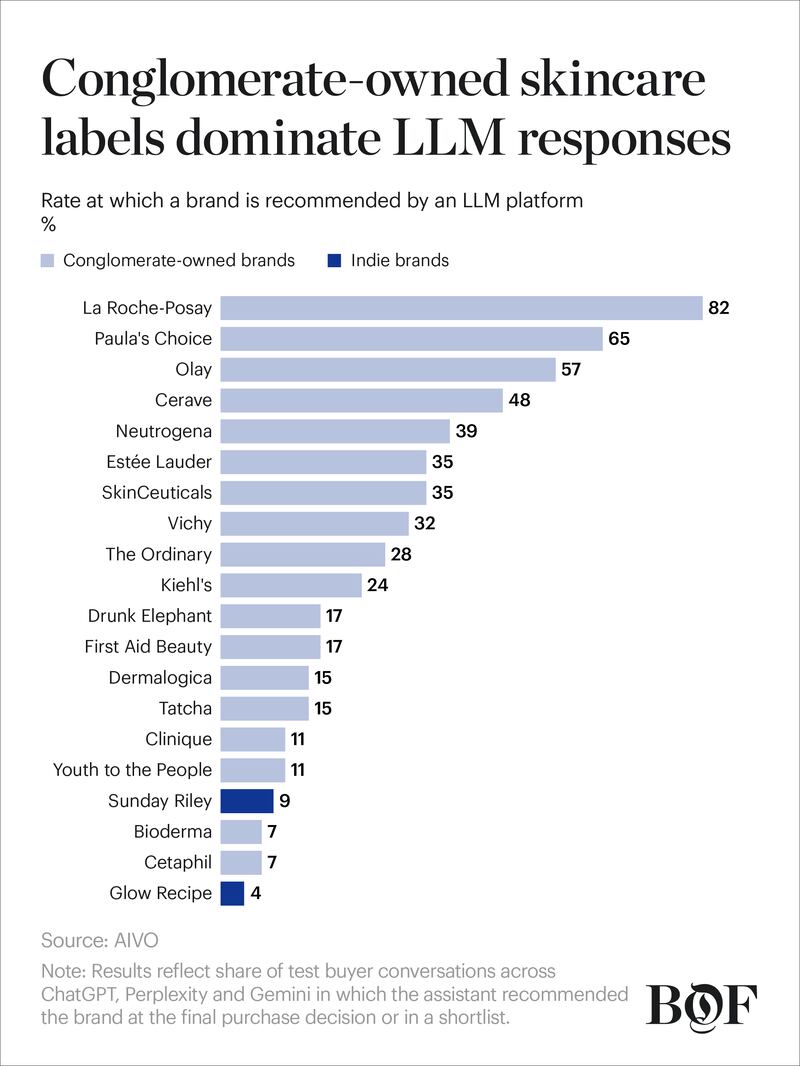
“If you’re a small brand, you’ve got to be extremely clear about what it is that you do to differentiate yourself,” said Tim de Rosen, chief executive and co-founder of Aivo. In hair, indie brands with a niche focus tend to be the ones surfacing: Divi and Act + Acre are focused on hair growth. Crown Affair emphasises air-dried hair, while Ceremonia is known for curls and clean formulas.
“A small brand cannot just try to go after the same strategy as a bigger brand,” said Ashu Dubey, co-founder and chief executive of AI consultancy Alhena.ai. Established names can invest in broad visibility, but indies are better off concentrating resources on one hero product, Dubey added.
On social media platforms like TikTok, trend-savvy disruptors are dominating shopping rankings, as a simple review from the right influencer can turn a label into an overnight success. AI is another story, however. LLMs tend to favour brands with an extensive online presence that can come from years of being in business or powerful parent companies.
One key reason is the sheer number of media mentions brands have been able to amass over the years with age and investment. While Reddit conversations and social media do have an impact on results, experts say that it’s the legacy media publications, known as “high-domain-authority websites,” that earn the best visibility. When asked skincare questions, LLMs tend to pull dermatological brands whose parent companies have invested heavily in clinical trials. But they also surface Glow Recipe, a US K-beauty-inspired label, and Sunday Riley, a gentle-but-effective prestige skincare line, which are frequently recommended by beauty editors.
According to Sunday Riley, founder and chief executive of her eponymous skincare brand, the label’s presence on LLM recommendations is due to several factors, including extensive media mentions over its 17-year-old history, as well as detailed site and social content with granular scientific information about ingredients.
“We’re making sure we have a ton of content on our site that’s relevant and really speaks to our point of difference,” said Riley.
Brands are increasingly tailoring their PR to AI platforms, tracking which outlets are cited the most alongside product recommendations. Divi and red-light mask maker Omnilux work with their publicists to incorporate LLMs into decisions on which media outlets to prioritise.
ADVERTISEMENT
Smaller labels also win when they unify their messaging around a very particular niche. Omnilux began investing in AI strategies after the company’s vice president of performance marketing and e-commerce, Caleb Orion, began noticing the brand’s spike in LLM-derived traffic and sales.
“Half of my brain is in LLMs,” Orion said. The company enlisted GEO firm Profound to make sure its website was readable to LLMs and start boosting site content. This included focusing on blog posts that aligned the most with LLM conversation topics; a high volume of people asking about the safety of red-light masks prompted the team to add more safety-related editorial content to its site. It expanded product names and descriptions, leaning on Shopify data for advice on wording and tags. Since the brand’s GEO strategy took off, Orion has been prioritising clinical trial information as well, creating a site section to link to relevant studies and ensuring their findings are summarised in blog posts.
As a 23-year-old brand that started out with medical devices owned by the privately held medical technology firm GlobalMed, Omnilux’s presence on LLM platforms has also benefitted from years of associations with dermatologist offices. According to Orion, that history has given it credibility to be mentioned in recommendations of its red-light mask, which marked the brand’s pivot to at-home, consumer-facing devices in 2020.
The brand also benefits from the fact that red-light masks remain a relatively niche category, automatically granting the differentiation needed to stand out on AI platforms.
“In our space, it’s a young category, relatively,” said Orion.
In Divi’s case, its hero scalp serum has been its standout product, given its place in a category less saturated than traditional hair care. The brand has heavily homed in on hair loss, filling its site with extensive blog content on the topic. “You want to prioritise the searches where you think you can win,” said Nihalani. It has focused on making sure its claims are consistent across the web, unifying language in product descriptions across its website, Amazon and Ulta Beauty, and enlisting its tech team to make sure all of its backend data was easily legible to LLMs. Last-click monthly sales attributed to LLMs have increased nearly 25 times from October 2024 to the present.
“We were always thinking it was the way of the future, but it was very quickly the way of the present,” Orion said.
Indie labels are also going up against beauty giants with the resources to ink deals with AI platforms. In June 2026 at the Vivatech conference in Paris, L’Oréal Group and OpenAI announced a partnership to help the company’s brands show up in several ways. While one of these is through paid placement, with an announcement that Skinceuticals, Cerave and Garnier are joining ChatGPT’s ad pilot, organic mentions are boosted by an agreement to improve product discovery with “enhanced signals,” according to the companies’ news release.
ADVERTISEMENT
Bigger companies are also tapping into the expertise of GEO agencies. In September, Estée Lauder announced a partnership with GEO firm Profound. Its plan is to improve its visibility across its entire portfolio, using the firm’s analysis to inform site and social content.
Brands only expect LLM usage for beauty recommendations to increase in the future.
Right now, the emphasis is on ChatGPT — September traffic from the platform was up 386 percent year on year for Omnilux. The company now sees 3.3 percent of its direct-to-consumer site sales from LLM recommendations, and projects the rate to keep growing.
The next frontier, according to brands and experts, will be agentic commerce. On Sept. 28, AI agent startup Instinct announced it raised $1 billion in a Series C funding round. Orion predicts that for Omnilux, use of AI in purchase decisions will get “bigger and bigger as all the big platforms promise agentic shopping” with the introduction of Meta’s Muse personal agent that debuted in September 2026 or Google’s agentic commerce tools.
As consumers adopt virtual assistants and receive increasingly tailored recommendations from ongoing chatbot conversations, brands are anticipating that advice may be about to get much less general.
“We’re moving from the mass LLM to the era of the personal agent,” said Nihalani. “It’s going to be one personal agent that has all of your contacts, knows what hair type you have, understands your budgeting limitations and can make a very personalised recommendation for you.”
Sign up to The Business of Beauty newsletter, your complimentary, must-read source for the day’s most important beauty and wellness news and analysis.
Loading recommended reads…
In this week’s High Margin, a search for images that cut through our visual fatigue — with leads from M/M Paris, Ferdinando Verderi and stylist Emilie Kareh. Plus: Tod’s designer exit; Burberry’s resilient sales.
The producer price index rose 6.5% from October 2025, an acceleration from the prior month, according to Bureau of Labor Statistics data out Friday. On a monthly basis, the PPI increased 0.3%.
The creative director and strategist joins Imran Amed on The BoF Podcast to discuss the evolution of his career, the realities of shaping artist narratives and why long-term collaboration outperforms short-term marketing.
The former Nvidia CEO was central to an AI boom that has propelled the US stock market and fueled the country’s unmatched luxury spending. After his exit, nobody is sure what happens next.