Agenda-setting intelligence, analysis and advice for the global fashion community.
Agenda-setting intelligence, analysis and advice for the global fashion community.
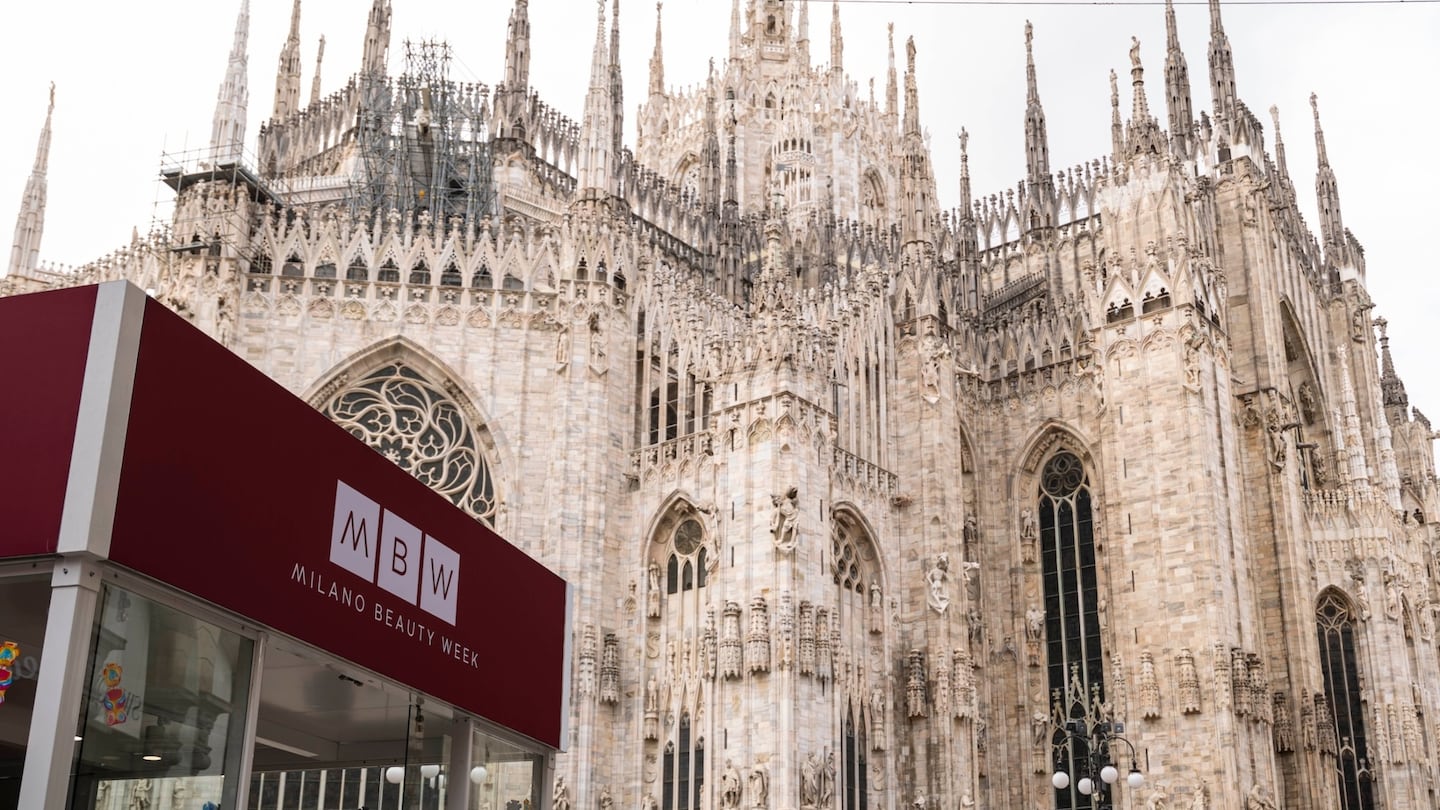
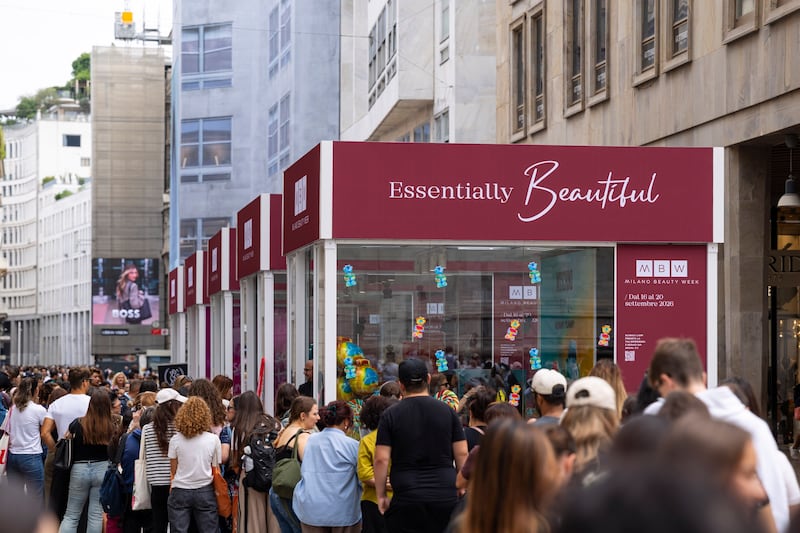
MILAN — It had been hotter than usual, was all anybody could say. The tail end of a punishing summer cracked like a whip. Throngs of people crowded Milan’s ancient sidewalks, all heaving bodies and fluttering hands, standing still beneath a glowering sky, waiting for the sweet relief that was promised to them at the end of the line leading to the Dolce and Gabbana My Devotion Eau de Parfum Intense kiosk.
The kiosk was one of dozens purpose-built structures built for September’s Milan Beauty Week, which was really more of a long weekend. From the Thursday to Sunday preceding Milan Fashion Week, the city swelled with shoppers, brands, manufacturers and press in celebration of Italy’s place at the symbolic heart of the global beauty industry. Italian brands like Armani and Pupa, retailers like Rinascente and Shaka and trade shows like Cosmoprof and Esxence held pop-ups and staged hundreds of events; connected on a map, they drew a heart around Milan’s city centre. The Beauty Week, which is put on by the trade body Cosmetic Italia, is free of charge and open to the public, with the aim of promoting the “excellence of Italian Beauty both nationally and internationally,“ said Benedetto Lavino, Cosmetic Italia’s president. It drew 270,000 visitors last year, according to its main sponsor, the trade body Cosmetic Italia. This year, it hosted 360,000.
Italian beauty was first exported globally in the 1960s Dolce Vita era, characterised by the tanned glamour of stars like Sophia Loren. But over decades, the concept has come to refer to an enormous industry that sits close to the beating heart of its home country’s economic pride. More than half of the world’s makeup products are made in Italy, largely in a stretch of land in Lombardy known as Beauty Valley, where major firms like Euroitalia, Ancorotti Cosmetics and Intercos operate sprawling industrial campuses. In some categories, like eye products, Italian formulas all but dominate.
As Italy’s more prominent fashion and luxury sectors have slumped, and faced renewed scrutiny over labour practises that undermine the craftsmanship behind “Made in Italy”, perfume and cosmetics exports have only swelled, totalling 18 billion euros ($20.4 billion) in 2025 and growing.
ADVERTISEMENT
Now in its fifth year, Milan Beauty Week looks a lot like a celebration, but a little like a subtle show of dominance to the rest of the world. While neighbours like France and Spain own fragrance, or competitors like South Korea gain on skincare, the Italian beauty industry has a renewed urgency to prove what it stands for — in style and in substance.
That international pressure could be felt at Milan Beauty Week. The majority of the exhibitors were Italian brands, like Kiko Milano, Pupa Beauty or Fanola hair care. But the weekend’s longest lines by far were for Shaka, the beauty retailer of Italian fashion group OVS, which boasts an edit of K-beauty brands like Tirtir and Fwee. Guests who made it to the end of the Dolce and Gabbana line were also rewarded, poetically, with a sample of My Devotion Eau de Parfum and a branded pouch. Others were given samples of the brand’s makeup products, all made in Italy — except for its new Rose Dew lip tints, which come from Korea.
In recent years, Italy’s manufacturers have been focused on increasing its fragrance making capabilities; alcohol-based perfumes are the fastest growing export group within beauty. These efforts were on full display outside Milan in Crema, where the major supplier Ancorotti operates its makeup and fragrance factories.
Outside Ancorotti Perfumes, there was Versace in the air. Inside, thousands of bottles of the Italian brand’s men’s and women’s scents, moody Eros and pop pink Bright Crystal, descended in fits and starts down four factory lines. A network of pipes filled each flacon from gargantuan vats in another room; nozzles were screwed into place by hand.
Italy’s perfume exports have surged in recent years. But these aren’t always entirely made in Italy: While firms like Ancorotti handle the bottling and packaging aspects of mass production, the juices themselves come from elsewhere — local Euroitalia, in the case of Versace, or French or Swiss firms farther away.
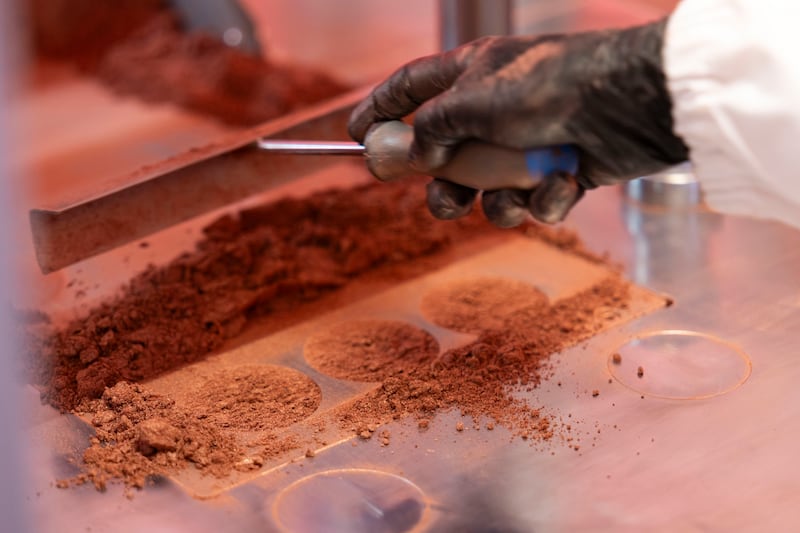
Ancorotti Perfumes sits next door to its cosmetics factory, which mints makeup products for brands from Byredo to Benefit to YSL Beauté to Natasha Denona. Owing to a number of business critical non-disclosure agreements, Ancorotti would not confirm which brands it services or products it has made. Its specialty is mascara.
Ancorotti, founded in 2009 by Renato Ancorotti and his daughter Enrica, has quickly become one of the country’s foremost manufacturers. The company’s family-owned structure is typical of Italian beauty firms. Intercos, the region’s largest factory — and the supplier of formulas like MAC Cosmetics lipstick and Armani foundation — was founded in 1972 by Dario Ferrari and is still majority owned by his family office. (L Catteron also has a minority stake.) It’s a philosophy that trickles down to the nation’s foremost homegrown brands, compared to the corporate giants of France or the young upstarts in Korea.
At Carthusia’s flagship store near the Brera, Virginia Ruocco, Carthusia’s head of product development and the daughter of its founder, said that fragrance was her family’s purpose. “Our brand,” she added, “is love.”
ADVERTISEMENT
Beauty insiders understand the quality of Italian products, and why artists like Pat McGrath insist on making their makeup there. But the rest of the world needs an education. Where “Made in Italy” could use a boost is in its non-makeup categories, including fragrance: The fact that some Italian labels still source scents from outside the country is something Cosmetic Italia is trying to change. (Dolce and Gabbana’s My Devotion is nosed by Olivier Cresp at dsm-Firmenich, and other brands like Armani, owned by L’Oréal, produce their fragrances in France.) Intercos acquired the company Cosmint in 2017 to build out its fragrance business, while Ancorotti Perfumes is developing its scent manufacturing to become an end-to-end destination for perfume production.
“More broadly, our goal is to ensure that cosmetics are increasingly recognised, both in Italy and abroad, as one of the country’s most dynamic and innovative industries,” Lavino said.
It’s possible to see a version of Italian beauty painted on the faces around Milan: A city of well-worn expressions, but immaculate complexions. Not glass, but Romanesque stone. It’s easy to see why the country’s biggest exports, like Armani’s Luminous Silk foundation or Colistar’s Gocche Magiche self-tanning drops, have generated billions of dollars bottling a version of lit-from-within radiance.
“The Italians know what sexy is,” said Satoshi Kuwata, who established his fashion brand Setchu in Milan in 2018. It’s a phenotype, sometimes expressed through olive skin that tans easily beneath the Italian sun. But it’s also more of an attitude: “A sophistication,” Kuwata added, “that’s not stuck up.”
Compared to their counterparts in, say, London or New York, Milan’s denizens are also adverse to plastic surgery. Italy ranks beneath other markets, like the US and Brazil, on facial plastic surgery, and even lower on body contouring procedures, according to 2024 data from the International Society of Aesthetic and Plastic Surgeons, its latest published survey. But the market is number three in the world for non-surgical procedures like fillers. Italy is also one of a handful of countries where hyaluronic fillers are injected more than neurotoxins like Botox.
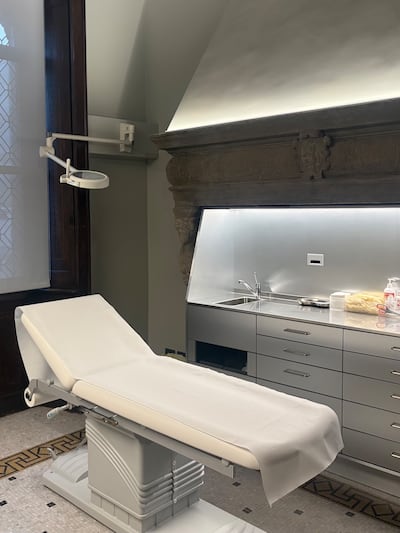
“We had an overfilling problem, like everywhere else,” said Giulio Borbon, the founder of Studio Borbon and an aesthetic surgeon in Milan with a reputation for treating the city’s fashion set. Borbon’s staff uniforms are designed by Prada, as are some of its surgical chairs. In 2016, “when I opened my practice, I was saying no to people all the time,” he added.
Studio Borbon, housed in a small palazzo on the western rim of the city, is as Milanese as it gets. The treatment rooms contain Renaissance-era touches — a fresco here, a fireplace there — carved out by sleek aluminium furnishings. The clinic’s skincare brands of choice, Biologique Recherche and Augustinus Bader, are French and Franco-German; Borbon’s aesthetic specialty, called “Pro-Fill,” uses small amounts of long-lasting fillers made of hyaluronic acid or biostimulating calcium hydroxyapatite to “balance” facial features.
As beauty trends and influences globalise, it becomes both more difficult and more urgent to define what Italian beauty looks like or stands for. But practitioners like Borbon, and brands like Kiko or Carthusia, suggest that it has less to do with a replicable face or scent profile than it does a feeling of connection. It’s a more valuable proposition, if a harder one to sell.
ADVERTISEMENT
“I don’t really care about perfection — I care about harmony,” said Borbon.
Sign up to The Business of Beauty newsletter, your complimentary, must-read source for the day’s most important beauty and wellness news and analysis.
In Italy’s key luxury manufacturing sector, more than 2,000 factories closed in the first three quarters of 2024. But innovative suppliers like Gruppo Florence are developing new models to navigate the pressures of a changing market.
Luxury’s biggest brands have tightened supplier oversight since a sweatshops scandal threatened to taint their reputations, but critics say compliance efforts have stalled and little has been done to tackle the systemic issues that enable labour exploitation.

Brennan Kilbane is News and Features Editor at The Business of Beauty. He is based in London, and supports BoF’s coverage of the multifaceted cosmetics industry, from fine fragrance to wellness trends.
Loading recommended reads…
A year into fashion's biggest wave of creative director changes, BoF's Chief Luxury Correspondent Robert Williams joins Sheena Butler-Young on The Debrief to break down which luxury houses have turned new talent into momentum — and which are still finding their footing.
The Westons agreed on Wednesday to buy the UK's Boots from Sycamore Partners and the Pessina family, pledging to invest in the retailer's stores and online and expand healthcare services.
The magazine’s inaugural ball will take place in November, the latest in a growing portfolio of live events hosted by publisher Condé Nast.
While conglomerates like L’Oréal and Estée Lauder dominate chatbot recommendations, independent labels like Divi and Omnilux are boosting AI traffic by targeting niche queries and overhauling backend data.