Agenda-setting intelligence, analysis and advice for the global fashion community.
Agenda-setting intelligence, analysis and advice for the global fashion community.


Tariffs, a prolonged luxury slowdown and volatile demand are making it harder for fashion and beauty executives to plan beyond the next quarter. While decision makers have never had more data, forecasting remains a challenge. At companies, the information needed to set budgets, forecast demand and manage inventory still sits in separate systems, owned by distinct teams.
Artificial intelligence could close that gap, but the fashion and beauty industry still views it with scepticism. Automation and generative AI could lift productivity gains by more than 30 percent over the next five years, according to The Business of Fashion and McKinsey & Company’s The State of Fashion 2026 report. But so far, returns have not been material.
A recent Bain & Company survey of 951 companies worldwide found that nearly 40 percent of those measuring AI’s financial impact had cut costs by less than 10 percent. The survey also found that the most-cited obstacle to AI progress was data access and integration, reinforcing the need to break down internal business siloes.
That gap between data and decisions is the problem AI decision intelligence platform Aily Labs was built to solve. Founder and chief executive Bianca Anghelina spent a decade managing global P&Ls in pharmaceuticals, most recently as head of global digital finance at Swiss multinational pharmaceutical company Novartis. While introducing machine learning into financial planning there, she saw critical decisions stall because supply chain, finance, commercial and product teams worked in isolation.
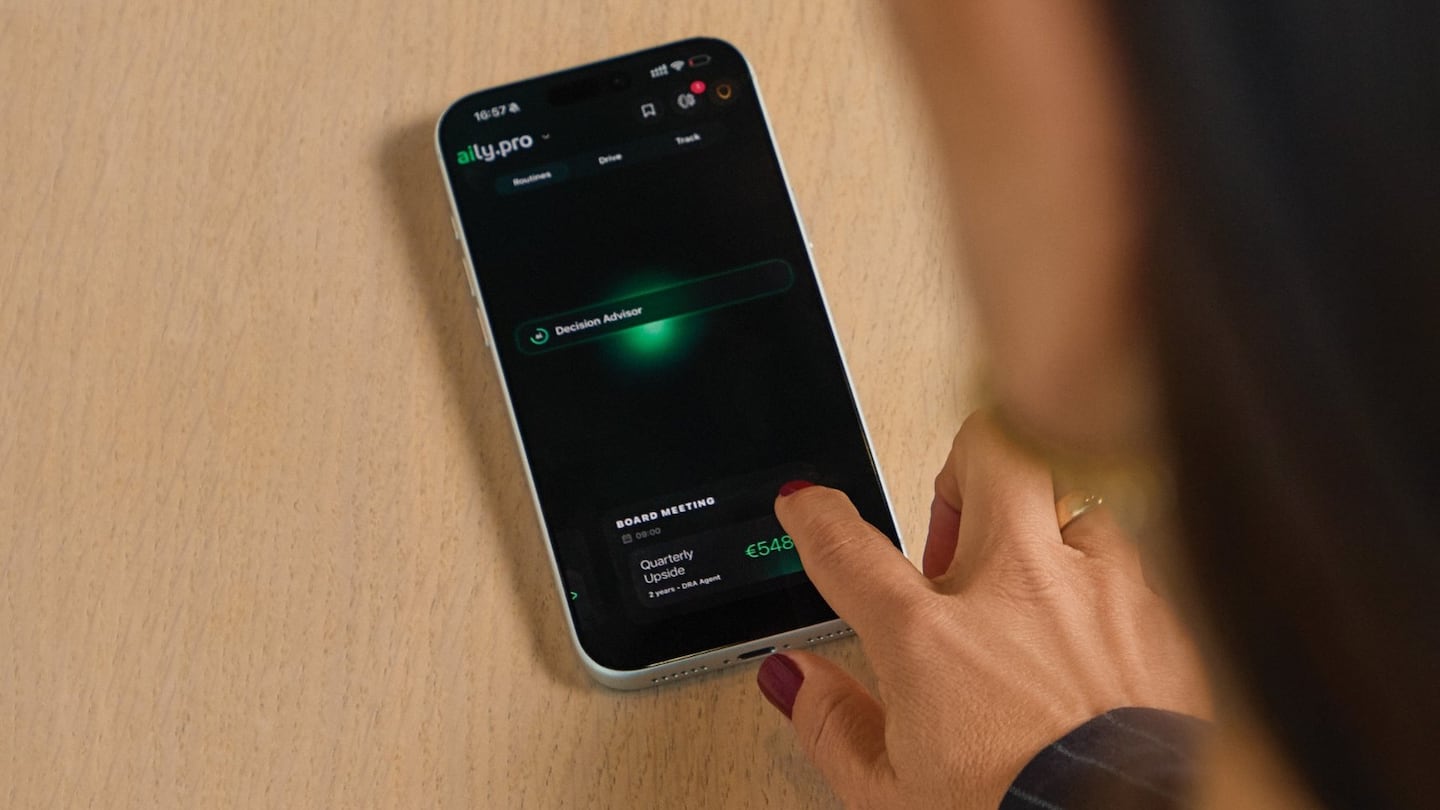
In 2020, Anghelina left the corporate world to found Aily Labs. Designed for business leaders, its platform connects data across a company’s functions and turns it into recommendations executives can act on from a mobile app.
A single interface, which the company calls the “super agent,” coordinates thousands of specialised AI agents across finance, supply chain and commercial operations, drawing on more than 300 validated AI models. Aily Labs reports revenue forecasting accuracy of up to 99 percent, which it claims outperforms in-house forecasts by an average of 10 percentage points. In one deployment at a Fortune 500 company, documented in a Gartner case study, the platform helped release around $685 million in inventory value.
Aily Labs now works with clients in pharma, retail, luxury and beauty, with offices in New York, Barcelona, Madrid and Munich. It has raised $101 million to date, including an $80 million Series B in November 2025 led by FPV Ventures, with Insight Partners and J.P. Morgan participating.
Its platform is cloud-agnostic, running on any cloud the company already uses, and its partnerships with Google Cloud and Amazon Web Services (AWS) let enterprises deploy Aily’s AI agents at scale without setting up new infrastructure.
For fashion and beauty leaders, the problems Anghelina tackled firsthand in the past are familiar: forecasting demand across hundreds of stores, reacting quickly when a product goes viral and getting every team working from a consolidated data set — to operate around a single source of truth.
Now, BoF sits down with Bianca Anghelina to learn more about the mission of Aily Labs and what AI can bring to fashion and beauty leaders who feel overloaded with data.

Why did you leave your corporate career after a decade to launch Aily Labs?
One of my first roles focused more on the systems side of the corporate world before I moved into owning full P&Ls and driving company performance. I always had different ways of thinking about how we could leverage technology to improve business. That was always on my mind.
With AI, I realised for the first time in my own role that we could see impact immediately. You didn’t have to wait years to implement software to see whether it worked. We could see the results in a matter of weeks. AI can really cut months of planning and deliver more accurate results.
I also spent a lot of time in boardrooms with the board, the CEO and the CFO discussing the business. I always felt prepared for any discussion, but there was never enough data at the table. I remember going to board meetings with folders full of slides and backups, ready for any deep-dive question. But in reality, there would never be enough folders to make real-time decisions.
That ambition to bring real-time, data-driven decision-making into the boardroom ultimately led me to found Aily Labs.
What convinced you of AI’s transformative potential in 2020, before its wider adoption?
I think I recognised both the opportunity and the challenge of AI early on. Having implemented AI in finance, I had seen its impact on my own role first-hand. That was back in 2018, long before AI became mainstream, and two years before I founded Aily. Even then, I was inspired by how technology companies were already using it to improve forecasting.
At the same time, I recognised the challenge of building a product that could connect every function of an organisation. There was no single role responsible for understanding a business across all its functions — and there still isn’t. The CEO comes closest, but a CEO isn’t going to build an AI platform at scale.
That’s where I saw the opportunity to develop a solution that could serve Fortune 500 companies across their organisations, and bring it to market much faster than they could build it internally.
I often think businesses need to stop turning siloed data into siloed AI — we have to break through this to get impact and scale. Breaking through that is key to ROI.
— Bianca Anghelina, founder and chief executive, Aily Labs
AI is now a priority for business leaders, yet measurable returns remain limited. Why has it been difficult to translate investment into impact?
We see productivity gains, but not yet P&L impact, because AI is presented as a tool for individual workflow optimisation as opposed to enterprise optimisation.
This is why we focus on connecting the dots across all the data and people in an organisation. We can then personalise insights for everyone from a CEO to a shop-floor manager, rather than just making individuals more productive. I often think businesses need to stop turning siloed data into siloed AI — we have to break through this to get impact and scale. Breaking through that is key to ROI.
What resistance or scepticism have you faced from clients, particularly in the early days?
It varied by industry. Mobile technology is perhaps more widely embraced in fashion than in other sectors. Early on, we encountered some interesting resistance. I remember people asking whether we could simply take their PowerPoint presentations and put them into a mobile app.
There was a significant education process involved. We had to explain that AI isn’t about presenting existing reports in a more accessible format, but about identifying opportunities and risks in real time that people might otherwise miss.
That was the first challenge back in 2020, before ChatGPT had made AI familiar to a wider audience. The next challenge is more fundamental: moving away from established ways of working and acting on AI’s recommendations.
The goal is to make the business more efficient and valuable so you can invest more in creativity and experiences — the two levers where the human touch matters more than ever.
— Bianca Anghelina, founder and chief executive, Aily Labs
What lessons from building an AI-first company could fashion and beauty leaders apply to their own organisations?
C-suite executives should start by identifying a single, easily understood process that cuts across the organisation, and explore how AI could improve it. I would recommend focusing on a simple, everyday decision that leaders already obsess over, such as assessing store performance. Even a seemingly straightforward decision like this touches multiple functions and levels of the business, making it a useful starting point for understanding AI’s wider potential.
This kind of change must be driven from the top. It is difficult to achieve the same impact through individuals adopting AI independently. A coordinated approach can deliver immediate benefits through greater transparency and real-time insights. Just as importantly, it helps identify the people within an organisation who are most enthusiastic about AI, who can be your champions for scaling it.
In creative industries, where should human judgement take precedence over AI?
The goal is to make the business more efficient and valuable so you can invest more in creativity and experiences — the two levers where the human touch matters more than ever. I’m passionate about helping the luxury and fashion industry get more comfortable with data-driven decisions.
At the same time, there is enormous potential for AI in areas that aren’t consumer-facing. It can improve forecasting by connecting commercial, clienteling, financial and supply chain data; optimise inventory so that the right products and sizes are available in the right stores at the right time; and help businesses identify emerging signals and shifts in consumer tastes earlier.
Looking ahead, brands that take these steps will become AI-native businesses, but they won’t necessarily be recognised as such. Instead, they’ll be known for what matters most: building iconic brands and delivering exceptional customer experiences. That’s ultimately the outcome I want to see.
This is a sponsored feature paid for by Aily Labs as part of a BoF partnership.
Loading recommended reads…
The company’s share price notched its biggest weekly rise since 2020 as investors bet on softer gold prices to bring customers back to stores.
Workers staged fresh demonstrations in Dhaka Thursday, forcing factories to suspend operations despite government promises to raise wages before the end of the year.
The cult menswear designer and former Demna collaborator is returning to Balenciaga as owner Kering seeks to revive sales at the French house.
Just a few years ago, commentators were declaring the brand as past its peak amid multiple ownership changes and a broader streetwear cooldown. Today, consumer tracking metrics shows domestic sales and youth market share is rebounding strongly.